

5-Star BOOK Reviews: Jushin Liger’s Books, Part I
By Alex Podgorski on 27 May 2026
Jushin Liger is one of the most famous masked wrestlers of all time. He revolutionized pro wrestling with his quick, athletic style and inspired an entire generation of wrestlers. Finn Balor/Prince Devitt once called him “timeless” and rightfully so. He won junior heavyweight/cruiserweight gold on three separate continents, has wrestled some of the most venerated wrestlers of the past four decades including Eddy Guerrero, Chris Jericho, The Young Bucks, Kenny Omega, Christopher Daniels, Fit Finlay, Bryan Danielson, Rey Mysterio, AJ Styles, Kevin Steen, Mitsuharu Misawa and PAC. Hell, he only had one match in WWE yet he was inducted into the WWE Hall of Fame as part of the Class of 2020. Yes, you can argue that was a publicity stunt but the general consensus is that Liger is a more or less universally-respected veteran who left an indelible mark on the wrestling business. And now we’re going to see things from his perspective:
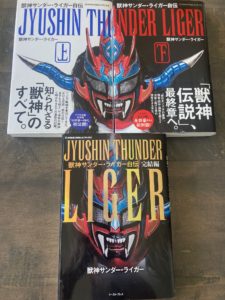
The Autobiography of Jyushin “Thunder” Liger*
Part One, published July 15, 2017
Part Two, published October 25, 2017
Part Three, published March 20, 2020
Part One covers the first 36 years of his life, Part Two covers the period from 2000 to 2017, and Part Three covers his final years culminating with his retirement match at Wrestle Kingdom 14. These books aren’t fully autobiographical in structure; instead they read as collections of interviews originally written on the NJPW smartphone site http://sp.njpw.jp conducted by Kazuya Matsui, who also had a hand in writing the three parts of Tetsuya Naito’s autobiography. As we go through these Liger books for the most part I’ll refer to him as “Liger” but there will be some instances where context requires that I refer to him as his real name, Keiichi Yamada or just “Yamada”. *Also, there are different transliterations of this name, with both NJPW and Yamada himself using “Jyushin”. However, for familiarity’s sake here on the Blog I’ll be referring to him as “Jushin”.
Part One starts with a cold open of sorts with Liger announcing his final participation in NJPW’s Best of the Super Juniors tournament. This announcement is followed by several excerpts from people exclaiming their respect and admiration for Liger including TAKA Michinoku, Hiromu Takahashi, Marty Scurll, Ricochet, Ultimó Dragón, and, last but not least, Will Ospreay, who calls Liger his number one hero and wishes to inherit the junior heavyweight division Liger built. It’s also noted that several people publicly call him a legend but Liger constantly refuses to accept such praise.
Chapter 1 Introduction to New Japan Pro-Wrestling
Liger skips all the customary talk of his birth and early life and begins with talks about his inspiration to pursue wrestling being Tatsumi Fujinami, whom he saw in a special edition of a Gong magazine with him on the cover. From there Liger recalls buying several wrestling magazines and tuning in specifically to watch Fujinami’s Dragon Rocket move and cites a WWWF Junior Heavyweight Championship match between Fujinami and Chavo Guerrero Sr. as his favorite match. He watched All Japan as well, being drawn to Mil Mascaras and the other foreigners who’d tour the country. He didn’t get International Pro/IWE because it didn’t broadcast in his hometown of Hiroshima. Despite his exposure to AJPW’s foreigners, he much preferred New Japan because to him their matches were harsher and he liked the rivalries between Japanese wrestlers (APOD: something I noted in my Jumbo Tsuruta book reviews that Giant Baba didn’t like booking). Liger recalls not being particularly athletic around the time he made the decision to pursue wrestling so he made up for this by doing lots of running around a nearby mountain. The consequence here being that his grades suffered as a result and for a while he only attended school for lunch and gym class. Since he was short, Liger joined the swim club in junior high presuming it would help him grow taller. He stood at 160cm at that point but this still wasn’t enough so he also applied for suspicious height-increasing methods advertised in Weekly Shonen Jump. He also began using various in-home training machines like Bullworker and Hercules Deluxe, which caused him to sweat so much that the tatami mats in his room began to rot. Further reading of wrestling magazines unveiled the industry standard of doing 3,000 squats so he began repeating these daily until he could. In the process, however, he developed an unusual physique for a middle schooler and his legs stopped growing (in length). Liger also reveals that, as a country kid, he was naïve to many things of the world, including romance, as he would use plain and direct language to confess his love to his school crushes, only to be rejected every time (APOD: put another one in the “amazing wrestler was a country bumpkin before making it big” column). His first live wrestling show was at Hiroshima Prefectural General Gymnasium and he remembers seeing Pedro Morales and Chavo there but he preferred getting autographs from Hiro Saito and George Takano, both of whom were surprised he wanted their autographs over the foreigners’.
Liger, like Kawada and Misawa, originally wanted to join a pro wrestling dojo immediately after graduating junior high school. However, at the time he was still too small, weighing only 70kg. So he enters Hiroshima Denki University High School to join their wrestling club despite failing a written entry exam. Once in, Liger would spend most of his time at school sleeping as he’d have to get up at 5am each day to deliver newspapers, then bike an hour to school, then stop by a nearby training centre to do weight training on the way home. Since he needed money for protein and gym fees, he couldn’t afford to skip on his part time job. Incidentally, Liger recalls losing to Kawada in a tournament in Tokushima and getting scolded by his coach.
Around this time he became far more focused on researching requirements to be accepted into NJPW’s dojo. One of these requirements was to be 180cm tall, which Keiichi Yamada certainly was not. While scouring various magazines for a solution, he finds an article about Hayato Mach, a masked wrestler who was active in IWE and the first UWF who failed NJPW’s entry test and went to Mexico instead and later became something of a reverse-import. To prepare for this excursion, Liger would watch NHK’s Spanish language course. As he approached graduation he began receiving wrestling scholarship offers from universities only to decline them to that he could prepare for Mexico. In a stunning twist, rather than get the typical dramatic arguments between an aspiring wrestler and their parents, Liger’s mother supported him wholeheartedly which stunned most of his teachers and guidance counselors. Here is where Liger gives a brief glimpse of his family life: his mother was an eternal optimist who lived doing what she likes. His father was apparently in a local-level band who would tour clubs while doing various manual labor jobs during the day. He also had a younger brother who was allegedly in a biker gang in his youth. Liger then reveals that his parents divorced when he was in second grade (APOD: Another one!) and his mother remarried two more times. However, unlike the single-mother trio of Misawa-Kawada-Kobashi, Liger doesn’t have any bad memories of absentee or abusive fathers, which leads to Liger concluding that his family live wasn’t violent or oppressive, merely complicated.
After graduating high school, Liger prepares for his Mexico trip and is put in touch with someone named Nagashima to help him since his Spanish isn’t yet up to snuff. Upon arrival at Arena Mexico, Liger is introduced to Leon Chino who runs a lucha school there. Chino has Liger do basic training and breakfalls/ukemi and then Nagashima introduces Liger to Gran Hamada who, a week later, introduces Liger to some New Japan guys on tour. This is where he meets Takano and Saito again, along with Nobuo Hoshinaga and famous NJPW trainer Kotetsu Yamamoto. After doing some basic drills and answering basic questions, Yamamoto offers to introduce Liger to more wrestlers who are partnered with NJPW through UWA. This presents a conflict for Liger since he’s currently training more or less for free with EMLL. Not wanting to be ungrateful to EMLL he refuses to switch to UWA, even if that means being unable to join NJPW. However, Yamamoto is understanding of the situation and tells Liger to contact him once he returns to Japan. Liger is shocked by Yamamoto’s consideration here and reveals subsequent comments Yamamoto would make in a magazine. Apparently Yamamoto saw Yamada’s potential the moment he met him. Yamamoto later tells Liger that he felt sorry for Liger and that he and the other NJPW guys would’ve felt guilty leaving Liger to starve and die in Mexico and that they would’ve found a position for him in/near a wrestling ring even if he didn’t make the cut to actually wrestle. However, Liger makes sure to point out that this entire period was only one month and not some months or years-long excursion that left him destitute.
Liger joins NJPW’s dojo in June 1983 which coincides with something called “The I’ll Kill You Incident”. Two major events had taken place around this time: Hulk Hogan beating Antonio Inoki in the IWGP Tournament and Tiger Mask I (Satoru Sayama)’s retirement and defection. Being introduced to the backstage side of wrestling during such a turbulent period helps build Liger’s fortitude and makes him better equipped at dealing with sudden and unexpected turmoil. Liger has a brief encounter with Sayama at NJPW’s dojo in Noge and then encounters Shunji Kosugi. However, Liger, being from the country, doesn’t understand the word for “new trainee” so a miscommunication between the two leads to a small argument. Then Liger meets a mix of other trainees and regular wrestlers from nearby staying at the dojo for convenience: Fumihiro Niikura, Nobuhiko Takada, Kazuo Yamazaki, Akira Maeda, Naoki Sano, and Hirokazu Hata. Liger/Yamada is quickly given the nickname “Hachibee” which affectionately means “big forehead” (APOD: the few publicly available photos of an unmasked/pre-Liger Yamada confirm this to be true). Liger goes through the usual round of training, inspired by doing so alongside some of his childhood heroes. One time Liger spars/trains with Takada and Liger cheekily admonishes Takada for going after the neck, thinking that doing so is illegal. Takada, however, continues because to him pro wrestling is about applying joint locks. After this baptism by fire, Liger wrestles Fujiwara, whom Liger refers to as a scary person. One day Fujiwara approaches Liger and asks him to box with him. After thrashing Yamada with ease, Fujiwara gives Liger a “pokaan!” on the back of the head (APOD: I have no idea what this means exactly but based on context I’m assuming it’s like a slap upside the head or some kind of mocking contact) to which Liger responds by telling Fujiwara “I’ll kill you”. Fujiwara calls Liger’s bluff and says “try me”, and Liger does. Big mistake. Liger doesn’t recall all the details but the next thing he does remember is being carried to his bed in the dorm and then waking up feeling nauseous. Reflecting on this in the present (i.e. 2017), Liger believes that if this were to have happened now it would’ve been an ambulance case. However, Fujiwara checks on him out of concern, Liger apologizes, and Fujiwara says he likes kids with guts. From there Liger would train with Fujiwara quite often, which Liger claims caused frustration to grow within him because he could never beat either one of them in a shoot wrestling match.
APOD: This look like a good spot to end for now. Thus far Liger hasn’t said anything too far removed from his All Japan counterparts: he saw wrestling one day as a child, devoted much of his youth to pursuing it, and found himself gatekept out of it for one reason or another, in this case, his stature. To remedy this he sought alternatives pathways in a time long before the internet and faster communication and discovered he stood a better chance at getting his foot in the door by struggling in Mexico. Liger doesn’t go into extensive detail on just how bad his time in Mexico was; however, Yamamoto’s words leave enough to interpretation for us to conclude for ourselves. Let’s see how much detail he provides in the next section when he talks about his in-ring debut under his real name.
As always, thanks for reading.