

5-Star BOOK Reviews: Jushin Liger’s Books, Part XII
By Alex Podgorski on 21 July 2026
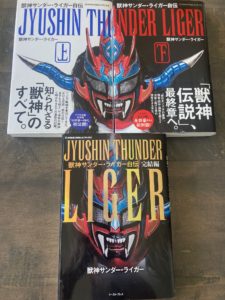
This next section of Jushin Liger’s books will cover a period of about four years from mid-2008 to mid-2012. This period sees Liger navigate less stormy waters from the initial Dark Age but there’s still an undercurrent of uncertainty. Liger spends more time wrestling abroad and for other promotions. He sees more outsiders come into NJPW to add new flavors to the same old wrestling. Another important figure in his life passes away. More changes in management ensue. Lastly, Liger once again shares his opinions of various wrestlers that stood out to him. But will he share anything overly critical this time around?
You can read part 1 here, parts 2 & 3 here, parts 4 & 5 here parts 6 & 7 here, part 8 here, part 9 here, part 10 here, and part 11 here.
Liger opens with his first appearance for Dragon Gate and how he wins their top title, the Open The Dream Gate Championship, within three months. Since DG is Toryumon’s spiritual successor, Liger sees many similarities between the two companies along with many elements of MPW. Once again Liger notices that a small promotion creates fans that gravitate towards a specific style or promotion and not pro wrestling fans in general. Once again Liger names wrestlers who stood out to him during his time there: CIMA, Dragon Kid, Mochizuki, BxB Hulk, YAMATO, PAC, and Ricochet. Then he mentions Wataru Inoue, a NJPW junior who retired due to injury but remained employed with New Japan with an office job. Liger thinks it’s rare for a pro wrestler to succeed in such a radically different role, but credits Inoue for having the right mindset to remain a good liaison between the office and the ring.
Next Liger mentions Milano Collection A.T. who wrestled during the same decade but also retired following an injury and became a color commentator. Liger recalls presuming he was Italian when he was actually from Iwate Prefecture. Liger recalls seeing Milano reading difficult books while on the tour bus and how he exceled in jabe (Mexican-style joint locks) that few others did in Japan.
After a few years, Liger’s stable CTU disbands with its members scattering and joining other groups. Liger joins a stable called LEGEND which, true to its name, is composed of high-profile veterans. Liger hoped that this group of legendary veterans would inspire competitive spirit in rival groups but, unfortunately, the group suffered from internal strife due to conflicting personalities. Liger also brings up the irony of being in this group: he hates being called a legend because the term overemphasizes his past achievements and the man prefers thinking about the present.
After some brief and general passages on Tetsuya Naito and Daisuke Sekimoto, Liger reaches the 20th anniversary of the gimmick’s debut. At Wrestle Kingdom III he teams with fabled rival Naoki Sano to take on Wataru Inoue and Koji Kanemoto. Shortly afterwards, he participates in a brief feud with Great Sasuke who puts on a special match titled “Great Space War” with Sasuke dressed like Ultraman. Later that year Liger participates in the fourth Super J Cup in December but loses in the first round to Naomichi Marufuji, who goes on to win the tournament. However, during the tournament an incident occurs that nearly steals the spotlight from the wrestlers. Kotetsu Yamamoto, who commentates during the tournament, loses his temper at DDT’s Danshoku Dino (APOD: For anyone unfamiliar, Danshoku Dino is somewhat infamous in wrestling for playing an extremely raunchy gay lecher best summarized as Goldust cranked up to eleven) after Dino hits a signature technique my translator interprets as a “gay killing move” (I am NOT googling those words since I don’t want to end up on some list). Allegedly Yamamoto didn’t appreciate Dino’s antics given NJPW’s serious reputation. Liger defends NJPW’s decision to invite Dino since he seemed to get over with the audience and recalls being the one to hold Yamamoto back from getting physical with Dino. That in itself was worth highlighting: Yamamoto had a fearsome reputation as a founding member of NJPW but Liger was on the verge of losing his temper and believes he almost lost his temper on Yamamoto.
As 2010 begins Liger embarks on a long tour of Mexico, where he is met with admiration. He recalls hearing fans mention his matches with Brian Pillman in WCW and seeing fans with tattoos of him on their legs. Around this time Liger was receiving more offers from overseas which Liger attributes to a new generation of wrestlers wanting to face their hero. Since he doesn’t refuse any offers, Liger uses this opportunity to grow his own unique position, especially after he wins the CMLL World Middleweight Championship. Liger also jokes that his mask is so iconic that many times while abroad his fellow wrestlers don’t recognize him in the dressing room until he puts on his mask, even if he introduces himself as Liger. Next Liger lists a few of the countries he has wrestled in: Pakistan, Iraq, the Philippines, North Korea, Taiwan, Hong Kong, the United States, Canada, Mexico, Palau, the United Kingdom, Italy, Germany, Russia, the Netherlands, Oman (APOD: records of his matches in some of these places might not exist so we may have to take his word for it). While he jokes about his family being jealous of his travels, Liger notes that he rarely, if ever, has time to visit tourist spots or explore these locales (APOD: This confirms what many WWE and WCW wrestlers have confirmed: despite their extensive travel itineraries most of their time is spent in one of a handful of places: the airport, the hotel, the gym, the venue, or some random eatery).
Liger briefly pivots to mention YOSHI-HASHI, now a NJPW mainstay, who initially failed the entrance test but was accepted afterwards when a successful candidate withdrew. At first Liger objects to this “promoted admission” since it went against orthodox processes, but with time he saw that HASHI adapted to the rigors of the profession and later apologizes to HASHI for doubting him. Liger uses him to recall another lesson told to rookies: a wrestler must have a strong voice. Liger compares wrestling to real fights that may take place in nightlife districts and how posturing and intimidation may trump actual physical contact. Thus, he instructs trainees to shout and yell so that they get comfortable showing physical confidence.
Then Liger talks about Kota Ibushi, whom he recalls wrestling one-on-one for the first time in 2009. Prior to coming to NJPW Liger heard Kuniaki Kobayashi praise Ibushi while they trained in Satoru Sayama’s gym but when Liger actually speaks with Ibushi he finds the younger wrestler to be a bit “airheaded”. His matches, however, impress Liger, especially with his fluid aerial moves and his kickboxing strikes. This leads to a conversation about training and how, when he was a rookie, Liger would show what he learned in training classes in his matches. However, Yamamoto scolded him when he did and Liger passed this mentality down when he became an instructor. A similar message would come from Yoshiaki Fujiwara, who’d tell Liger “Show something beyond practice in your matches” which Liger did.
After that Liger discusses Prince Devitt and praises him for adapting to a different culture from his own. Apparently Devitt was chubby when he started with New Japan but trained hard and developed a “sharp” body. They appear to remain friends, with Devitt thanking Liger backstage when Liger wrestled in NXT in 2015. Next is KUSHIDA, whom Liger initially dismissed as a “hopeless young boy” but over time adapted thanks to his background in MMA and lucha. Liger puts over the harshness of NJPW’s training, with most outsiders struggling to adapt but homegrown applicants generally faring better since their progress is watched carefully by the trainers. This leads to another foreigner, Kenny Omega, who first wrestles for NJPW in 2010. At the time Omega had an overwhelming comedic image from DDT, but Liger notes “those who stand out will stand out” and he describes Omega as exceptional from the start. At one point Omega tells Liger he admired him since he was a kid, which Liger finds gratifying.
Around this time, while Liger’s touring in Mexico, Kotetsu Yamamoto passes away suddenly to hypoxic encephalopathy at 66 years old. Liger initially wants to return to Japan for the funeral but then he recalls Yamamoto’s lessons and concludes that Yamamoto would’ve demanded he finish his tour, which he does. This brings up a treasured memory of Yamamoto’s wife telling Liger that Kotetsu once said “Yamada is serious and trustworthy”, which makes Liger cry uncontrollably. Another memory that comes up is their first encounter in Mexico. Yamamoto asks Liger how he’s getting by and Liger answers “I get by on two hamburgers a day”. This prompts Yamamoto to lambast him, saying “a wrestler’s body is his capital” and gives him more money for food (APOD: This is likely how the “Liger was starving in Mexico” narrative first emerged). That money allows Liger to buy steak and make his body bigger. Liger describes Yamamoto as the “symbol” of the New Japan dojo but that largely ended once Hiroshi Hase took over training and incorporated rational elements into the training process. On that note Liger touches on the difference between New Japan and All Japan and how much of this discussion has centred on AJPW emphasizing breakfalls in training while NJPW, allegedly, did not. Hase, for his part, is one of a very small handful of wrestler to train under both Inoki and Baba.
After a brief tangent on his closeness with Osamu Kido, Liger gets into the Bushiroad Era of New Japan. This opens with the CMLL Fantastica Mania tour, which has become something of an annual tradition following the year-long friendship cultivated between NJPW and CMLL. This leads into a discussion on lucha in general and how Liger appreciates it. Most people associate it with high-flying but there’s a grounded component as well which Liger referenced earlier with jabe. One time, while wrestling a luchador named VIRUS, he and Liger spent most of the match doing technical grappling. Liger briefly mentions a lucha success story in Mascara Dorada, who Liger heard grew up illiterate yet made enough money wrestling to buy a house for his parents. Liger also compares the locker room atmospheres and national characters between Japan and Mexico, how the latter is far more passionate and cheerful.
This cheerfulness disappears as Liger pivots to a major tragedy in the 2011 Tohoku Earthquake. While the epicenter was far away closer to Sendai, Liger recalls feeling it while attending NJPW’s dojo in Tokyo and seeing the ground writhing like a snake. Somehow, the dojo, run down with some pillars held together with duct tape, remained standing. Shortly afterwards the three biggest promotions hold a joint show called ALL TOGETHER which functions as a charity event for the victims. Liger is initially hesitant about the idea but once he sees and hears fans thanking the wrestlers for coming he changes his mind.
Around the same time Yuke’s sells NJPW to Bushiroad which comes as a surprise to all the wrestlers. At first Liger finds the announcement “anticlimactic” and credits Yuke’s for saving NJPW from bankruptcy. Liger was also a bit unsettled over the situation, thinking that the wrestlers still owed gratitude to Yuke’s for saving the company and that the backroom nature of the deal was a bit off-putting. After a short while, Liger gets the opportunity to meet the new owner Takaaki Kidani and his first impression is that Kidani is easy to talk to and respects the wrestlers. Although Kidaani encourages NJPW wrestlers to express themselves openly particularly through social media, Liger finds this hard to do as an “analog person.”
Liger jokes about himself for a moment and really leans into the old man characterization. At one point he gets fired up over Naito’s treatment of the Intercontinental title belt (APOD: during 2016-2018, Naito would launch the belt into the air, damaging it gradually until it began to fall apart), only for his younger peers to try and calm him down. In general though, Liger feels the internet is too impersonal for him, hence his reluctance to communicate through it.
From there Liger pivots to discussing Kazuchika Okada and his return in 2012. Liger notes that, like Tanahashi, Okada was booed initially but gradually won the fans over with his wrestling. Liger recalls Milano once describing Okada as “having hair growing on his heart”, referencing his dedication and willingness to overcome controversy and adversity. Liger compares people to bonsai trees, how you don’t meddle with their growth at first, let them bask in the sun freely, only shaping them if they bend in a strange way. Liger also notes that, years earlier when he worked an independent event promoted by Okada’s trainer Ultimo Dragón, no one knew what Okada would become. Liger recalls seeing Okada’s fighting spirit in tag matches and eventually negotiated with Ultimo to have Okada transfer to New Japan. Liger notes that despite training in Toryumon, Okada started from the bottom once his transfer was complete he worked hard, not wanting to tarnish his mentor’s reputation.
Liger notes that, up to Tanahashi there remained a constant connection to Inoki (APOD: This is a bit tenuous since little of Tanahashi’s style or image can really be compared to Inoki). This constant ended with Okada, who is considered the symbol of new, reborn New Japan. Liger compares Okada’s growth and acceptance to the Will Ospreay/Vader situation from ~2016 and noted that there will always be generational divides between fans who think their era of wrestling was the best.
Next Liger talks about Taichi and how he was the third person to ever summon Kishin Liger, This took place after Taichi ripped Liger’s mask, and whenever that happens Liger stops wrestling with limits. At the time Taichi had a classical heel-type persona, which was rare for NJPW since most of their villains were, traditionally, foreigners.
Finally, Liger talks about another tour of Pro Wrestling NOAH which, like before, retains its dedicated, outside-company-hating fans. He recalls some people trying to grab him and there were times when he did indeed react like a short-tempered old man. During this period he wrestles in junior heavyweight tag matches which introduces him to teams like Forever Hooligans (Rocky Romero & Alex Koslov), the Young Bucks (Matt Jackson & Nick Jackson), and reDRagon (Kyle O’Reilly & Bobby Fish. Sometimes he’d commentate for such matches in NJPW and would often “give up” trying to call the action because they’d get too complex for him to follow. Liger recalls a message he once got from Riki Choshu, who told him, “Just because you’re juniors doesn’t mean you have to fly around or do flashy moves. Aerial techniques exist to compensate for physical disadvantages after wrestling properly. So you have to wrestle well.” Liger thinks that the current juniors starting off at high speed works since it’s popular with the fans. He notes that pro wrestling has always had trendy styles depending on the era and while this current thing appears to be working with this new audience, he prefers to stick with what his seniors taught him.
APOD: Once again Liger doesn’t provide much beyond milquetoast opinions or anything groundbreaking. He appears to be sticking to the stereotypical notion of not rocking the boat when discussing anything and leaves any criticism delicate or passive. That’s fine and all but for someone who has traveled the world and been such a staple of the business you’d think he’d have a few more biting opinions about what worked and what didn’t. Still, at least Liger’s polite and respectful enough to put over whoever he can however he can, including contentious individuals like Omega and Ospreay. Maybe that’s why he’s so admired (or, as Devitt/Finn Balor called him, “timeless”): rather than turn into another curmudgeonly veteran stuck in his heyday, he approaches wrestling with a perpetual glass-half-full mentality and wants people to appreciate it however he can. Such a positive attitude certainly adds to his respect, but for people looking for drama, you’re unlikely to find it with him.
As always, thanks for reading.