

5-Star BOOK Reviews: Jushin Liger’s Books, Part X
By Alex Podgorski on 6 July 2026
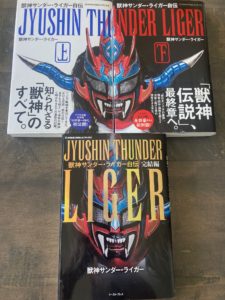
Welcome back to my coverage of Jushin Liger’s books. Apologies for the delay in writing these; I’ve been dealing with a sick parent and couldn’t find much time to get down to write these. Still, if you’re still coming back, thank you for your continued support. This time around we’re going to cover a two-year period between the spring of 2000 and 2002. This period saw Liger navigate a turbulent New Japan and a turbulent wider wrestling industry. Not only was New Japan going down the Inokism path but its business was also affected by the NOAH Exodus and the departures of both Keiji Muto and Riki Choshu. Liger, ever the company man, tries to solve problems and quell unrest, even at the cost of his own wellbeing. Then again, that it perhaps one reason why he’s regarded as such a legend: he wasn’t one to refuse which led him to compete in new environments and fare far better than most people expected.
You can read part 1 here, parts 2 & 3 here, parts 4 & 5 here parts 6 & 7 here, part 8 here, and part 9 here.
Liger opens with a discussion on the 2000 Super J Cup, this time hosted by Michinoku Pro Wrestling and switched to a two-day format. Liger initially doesn’t want to participate because the tournament goes against his storyline at the time of challenging heavyweight following his 1999 “lukewarm” comments. However, he changes his mind following pressure from Great Sasuke. This tournament features sixteen participants from ten promotions, including new promotions Wrestle Dream Factory and Battlarts. Two notable participants are a young Shinya Makabe (before he’s rechristened as TOGI Makabe) and Gran Hamada, whom Liger had wanted to face for many years. Liger wins his second J Cup, beating Tiger Mask IV in the first round, Men’s TEIOH in the quarterfinals, Gran Hamada in the semifinals, and CIMA in the finals. CIMA later credits Liger creating the J Cup as the platform he needed to get exposed to a wider audience and thanks Liger for his contribution.
From there Liger pivots to the 2000 G1 Climax tournament which differs from previous tournaments by following the four-bracket format instead of the standard two. Liger is one of two juniors participating in this tournament, alongside Tatsuhito Takaiwa. Liger experiences opposite fortunes here as he loses to Yuji Nagata, Takashi Iizuka, and Tatsumi Fujinami, with his only win coming against Tatsutoshi Goto. Once again Liger does his best to say something positive about these experiences. He highlights Goto managing to lift 300kg of weight and Fujinami being a significant influence on him through his matches against Dick Murdoch, Adrian Adonis, Big Van Vader, and Andre the Giant. At the same time, Liger notes the tournament’s grueling schedule led to injuries: having it condensed into a five-day stretch leaves him with an injured neck, hips, and a partially dislocated shoulder. Liger points out that even now with the G1 stretched over a month with alternating brackets, there are still cases of participants withdrawing midway through due to injury. Liger further stresses the difference between junior and heavyweight divisions, stating that the G1 is much more grueling because those wrestlers have much more weight to carry around and bump with. He describes this experience as both an accomplishment and a wall that he couldn’t overcome. He speculates that, had he somehow won the heavyweight title, he would’ve found himself in limbo, despite those experiences broadening the scope of his wrestling (APOD: This might explain why wrestlers like Kenny Omega and Will Ospreay moved up to the heavyweight division without significantly changing their wrestling styles).
On the final night of the G1 NJPW experience a shock in the surprise appearance from AJPW’s Masanobu Fuchi. In typical AJPW gentlemanly fashion Fuchi cuts a promo that can be summarized as, “I’M HERE TO BREAK THROUGH THE WALL…sorry for the fuss.” Liger is ambivalent towards the AJPW/NOAH situation, thinking that things will work out somehow. He shifts towards a general discussion on the NJPW/AJPW rivalry, noting how there was always a competitive spirit between the two rosters which led to the industry’s growth. Liger expresses regret over never learning any wrestling from Giant Baba and is envious of Hiroshi Hase having being one of the rare few to train under both Baba and Inoki (APOD: In his books, Hase goes into extensive detail on the lessons he learned from Baba and considers him a better teacher on pro wrestling fundamentals while Inoki arguably the better wrestling businessman). Liger concludes this chapter with his singles match against Fuchi in early 2001 (APOD: a great match, you can watch it here) and condenses the philosophical differences between Baba’s and Inoki’s wrestling like this: “Mr. Inoki is like ‘If the cuckoo doesn’t sing, kill it,’ while Mr. Baba is like, ‘If the cuckoo doesn’t sing, wait until it does.’
As Liger moves further into 2001 he recalls more memories of Riki Choshu’s time managing the field (APOD: a common term in these Japanese books to describe the booker/matchmaker). Choshu clashed with many people including Shinya Hashimoto (who was at one point was player’s chairman/head of the wrestlers’ association), Shinjiro Otani, and Takaiwa. Liger speculates that their poor treatment by Choshu spurred their departures to Zero1.
Around the same time new wrestlers appear, including Masahito Kakihara (coming from AJPW) and Masayuki Naruse (coming from Fighting Network RINGS), both of whom have more MMA-oriented styles. Despite their styles being timely amid the MMA boom, Liger recalls seeing them both struggle in New Japan at first. Liger reasons that while they were good fighters, they lacked the ability to make their Strong Style entertaining. Liger makes a banal but often forgotten observation how anyone who stands in front of people has to think about how to entertain.
Thing take a lighthearted turn for a moment as Liger summarizes different people to mature into stars around this time. He says everyone loved being around Hiroyoshi Tenzan for being clumsy but in a funny way. Satoshi Kojima was reliable. Yuji Nagata was inherently savvy thanks to his upbringing as the son of educator parents. Osamu Nishimura overcame preconceptions of being a snooty rich kid by working extremely hard and even clashing with Choshu. Then there’s Manabu Nakanishi who was clumsy like Tenzan, to the point that Liger nicknames him “Wild Man”. Liger recalls Nakanishi serving him octopus without tenderizing it first and seeing him buy a whole salmon at a fish market and biting into it headfirst.
Back to wrestling, Liger continues splitting his time between weight classes, as seen with his G1 Junior Tag League participation alongside El Samurai and the G1 (Heavyweight) Tag League alongside Nishimura. Liger credits his success in both divisions with Kotetsu Yamamoto’s teachings: since Liger couldn’t make himself taller bulked up to make his sides bigger. He also credits his success to strategy: he’d act as a disruptor or distraction so that the heavier Nishimura would roll-up opponents or otherwise capitalize on the chaos. Then Liger talks about his experiences with bigger heavyweights: his fondest memory of Andre the Giant is both him and his wife being asked to buy Andre his alcohol; he summarizes his experiences with El Gigante as “not fun”; Vader was an imposing and troublesome opponent; and Scott Norton was determined to work through injuries, which translated into wider respect and greater career longevity.
2002 begins with Keiji Muto’s defection to AJPW which invites a wider discussion on the Inokism era and how two of the Three Musketeers were now gone. Liger prefaces his thoughts with “I think the statute of limitations has passed” on what he can say. He recalls Hashimoto revealing to him his plans on leaving but Liger pushed back by saying that the Three Musketeers had to move together since they were a brand. Following Muto’s departure Chono, the sole remaining Musketeer, spearheaded something called “the Inoki Dialogue” which allows wrestlers to express their grievances. Liger doesn’t participate because he doesn’t think having such a dialogue in front of fans will solve anything. Liger recognizes Inoki’s growing push towards MMA and concludes that while NJPW wrestlers practices legit joint locks in the dojo, they were unprepared for striking. He states that while it was foolhardy to book wrestlers in MMA fights, he also admits that their dojo training should’ve included striking.
Another negative factor affecting NJPW at the time is a collection of exposé books that paint pro wrestling in a bad light. Although Liger ponders whether fans would really delve deep into such books or dismiss them as quick curiosities, such books leave a bitter aftertaste among the fandom. This, combined with MMA’s popularity, leads to a general sense that pro wrestling is a stepping stone into MMA. Liger recalls seeing little activity from NJPW to either acknowledge or counter any of these negative claims. Their apathy and inaction, Liger argues, contributes to an environment of an alarm sounding yet no one taking action until it’s too late.
Around the same time Liger finds himself enveloped in a crosspromotional feud with NOAH. Liger’s competitive fire is ignited by two events happening in close proximity: Naomichi Marufuji taunting him with claims that NOAH’s juniors are the best and Nagata failing to capture the GHC Heavyweight Championship from Jun Akiyama at the 2002 January 4 Dome Show. Around this time Liger observes differences in the promotions’ crowds: whereas NJPW fans would react positively to any action regardless of which side showcases it, NOAH’s audience was far more protective and booed NJPW wrestlers.
Once again Liger praises another wrestler, this time it’s Marufuji, whom Liger calls a versatile genius with athletic ability and quick wit. He uses Marufuji’s success to open up discussion on the stylistic differences between companies, In particular, Liger recalls witnessing Yoshinari Ogawa teach NOAH rookies and there were subtle yet distinct differences in methods and content. This amazes Liger because it shatters his preconception about pro wrestling being so limited in forms. These differences lead to a push-and-pull dynamic in his NOAH matches which, in turn, leads to better fan reactions.
However, Liger isn’t all happy in general. NOAH’s initial success over NJPW combined with the growing threats of MMA and the exposé books, all leave him irritable after matches. Part of this general frustration stems from Riki Choshu’s departure to form World Japan and the resulting chaos in NJPW’s backstage environment. Liger tries to find a silver lining in NJPW’s new Los Angeles dojo and credits it for producing talents like Rocky Romero, Karl Anderson, Prince Devitt, and Bryan Danielson. However, Choshu’s replacement as head booker, someone named Uwai, pushes the MMA fighter thing heavily, which leads to fighters acting arrogantly in front of wrestlers. Liger’s most pointed criticism thus far is directed towards Makai Club, a stable of MMA fighters led by Tadao Yasuda who all worshipped Inoki as a god. Liger describes Yasuda as a likeable guy but rough around the edges in the ring. He also recalls another Inoki experiment happening around the same time, that being Chyna’s appearance in NJPW. Liger appreciates Inoki’s attempt at being ahead of his time but this one was a bit too much for both NJPW wrestlers and their fans. Liger in particular sees her appearance as a publicity stunt and appreciates Chyna’s physique and training but still recalls instinctively holding back when wrestling a woman.
Another expression of the general chaos of the time was Liger’s MMA fight with Minoru Suzuki. This was originally meant to be Suzuki vs. Kensuke Sasaki under Vale Tudo rules but Sasaki withdrew, alleging a leg injury. However, Liger speculates that was only a public explanation: backstage, Sasaki protested the match (despite him and Suzuki promising to face each other one day when they were younger) because NJPW negotiated it with Pancrase without notifying Sasaki. Given their stylistic differences, Sasaki was left with little time to prepare and thus refused to go into a situation that would make him look bad. Liger suspects there were other negotiations ongoing, also without Sasaki’s input, which made him distrust the company even more. As for Liger, he didn’t directly volunteer for the fight; instead, Umai asks him and Liger accepts hoping it would settle some of the ongoing chaos. For some reason, Sasaki, seeing Liger accept so easily, leads him to reconsider, which leads to even more complicated negotiations. Ultimately, Suzuki wants the fight to move forward with Liger since Sasaki took too much time coming to a final decision.
Liger has no experience with MMA so he reaches out to trainees like Naruse for help. With no time to improve his striking game, Liger focuses on improving his grappling game. This, he recalls, proves to be a mistake. Once the fight starts Suzuki manages to dodge everything Liger throws at him effortlessly and chokes him out quickly. Despite its short length, both Suzuki and Liger call this a dream experience. Liger is given plenty of praise backstage for doing this, both from his NJPW side and the Pancrase side which includes Suzuki and Masakatsu Funaki. This experience leads Liger to start training in martial arts outside wrestling, particularly in jiu-jitsu. As of this book’s publication in 2017, Liger has a purple belt in jiu-jitsu. It also leads Suzuki to return to pro wrestling and both men going on a fishing trip together. Contrary to his menacing appearance, Suzuki is actually a warm-hearted person (APOD: Can confirm, Suzuki’s really chill in person). Liger concludes this section with a brief look at Sasaki, who had a rebellious spirit which stemmed from what Liger argues is jealousy towards the Three Musketeers. Liger also thinks that Sasaki departing NJPW was good for him because it broadened his horizons.
APOD: This was one of the more interesting sections of Liger’s books. He used hindsight as a means to reflect on what happened during this tumultuous period and proposed practical differences that, perhaps, would’ve altered the course of history. Liger never directly criticized Inoki, Uwai, or Choshu directly as such isn’t in his nature. But by framing all of these as observations or feelings Liger managed to paint enough of a picture without targeting anyone in specific or being overtly negative. He embraced a silver-lining philosophy, always looking for something nice to say about anyone, even if said qualities weren’t strictly related to wrestling. Unfortunately Liger doesn’t go as deep on any one topic as he could, either because he’s still trying to avoid causing tension or because it just isn’t in his nature to be negative towards anyone but himself. What we’re left with is a series of interesting anecdotes and perhaps a few small surprising tidbits but nothing groundbreaking, which is unfortunate given Liger’s importance to the wrestling business. But maybe that’ll change as we continue along this journey.
As always thanks for reading.