

5-Star BOOK Reviews: Akira Hokuto’s Books, Part II
By Alex Podgorski on 19 March 2026
Last time Akira Hokuto found herself at a critical juncture in her life: deciding on whether to pursue professional wrestling. This section will follow and will introduce her first challenge as part of that life path: her application, auditions, and initial life as a trainee. Here we’ll see the world of zenjo from a trainee’s perspective and through Hokuto’s first experiences we’ll get a sample of what that life was like. If you’ve followed my reviews of male wrestlers’ books then you’ll have a vague idea how strict, difficult, and regimented trainees’ lives were during the 80s and 90s. So now let’s see if women’s trainees had it easier, harder, or just as rough.
You can read part 1 here.
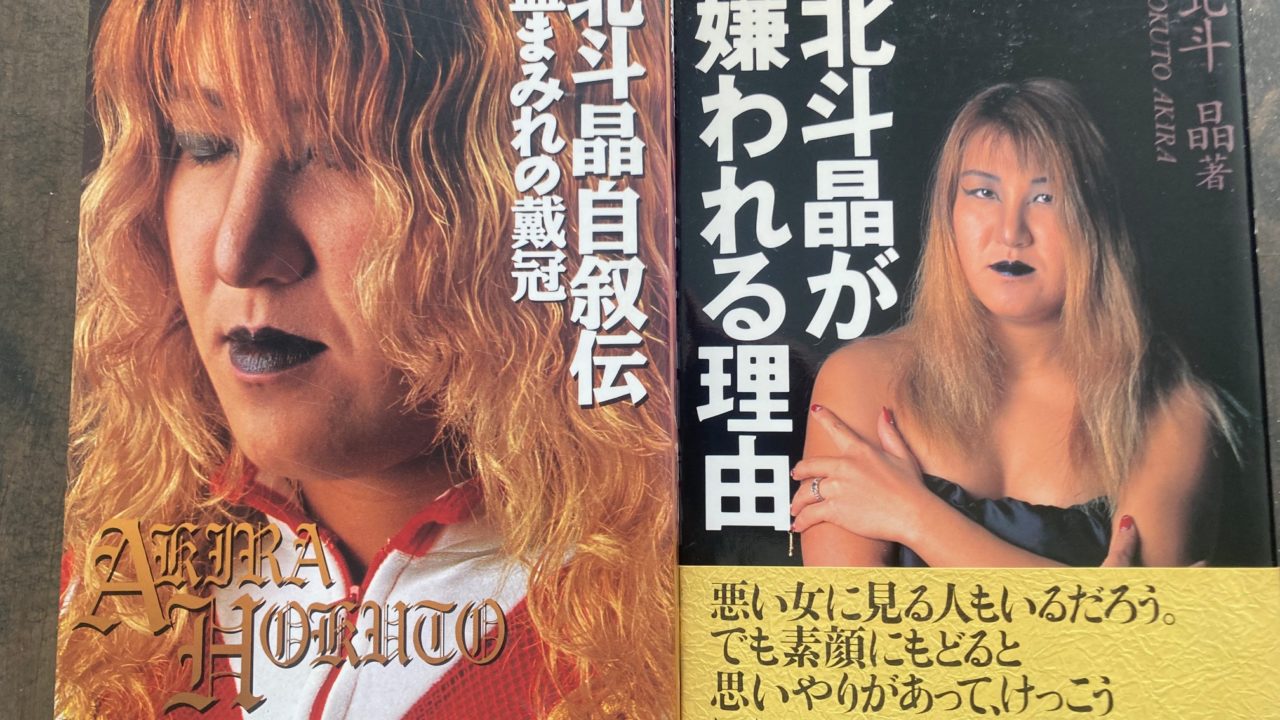
Part 2: Introduction to Japanese Women’s Pro Wrestling
After apologizing to her grandfather for the terrible things she said last time, Hisako embarks on her wrestling journey and finding a job to pay for it. She gets a job working at a 7-Eleven earning 630 yen an hour hoping to make 20,000. In an ironic twist, Hisako recalls her older sister being a fan of the Beauty Pair when they were both younger but she gradually lost interest while Hisako’s the one entering the field. Hisako also remembers recognizing the Crush Gals because they were that popular.
Hisako arrives at AJW’s dojo and sees about fifty other young girls with the same aspirations. She undergoes basic training, which has no set routine, and notes how anyone could become a trainee so long as she paid the entrance fee. The only requirements at the time was that a girl had to be at least fifteen years old, be a least 160cm tall, and weigh at least 60kg (APOD: the weight requirement is interesting because that converts to about 133 pounds and I’ve seen a few women’s wrestlers on both sides of the Pacific who look way skinnier than that). Like her peers Hisako is anxious about the tryout but her case it’s worse because she’s already sixteen. She worries that her training timeline would delay her pro debut until age 20, which would only give her five years’ worth of pro time due to the mandatory retirement at age 25 (APOD: These sources have inconsistent info on whether AJW’s retirement age is 25 or 26. It might not seem like much, but for these women one year makes a TON of difference). This is also perhaps the only instance in which a woman can call herself an old-timer at age 16, 17, 18, or 19, and there actually be some truth to it.
Hisako describes the different girls around her who had come from all over the country. Some had dropped out of school, others were working part time jobs, and one was already on her third entry test. Hisako had one benefit the others didn’t: she still lived at home and commuted to Tokyo whereas many of the other girls had to rent apartments in the city.
At the time acceptance letters came by postcard so Hisako spends an unknown amount of time waiting impatiently for her letter from AJW while her friends from training get theirs. Sometimes she’d resort to prayers while holding back tears hoping something would appear in her mailbox. Eventually, in January 1985, she grows tired of waiting packs her bags, and goes to the venue to inquire in person. Her mother and grandfather decide to accompany her but she asks them not to because she doesn’t want to see her beg and grovel if she finds out she has been rejected. Hisako arrives and learns that there must’ve been a clerical mistake so she’s given an applicant number. Then she learns that 35,000 girls had applied to be wrestlers but only 700 passed the document screening, including her. Of these 700, only ten are accepted each year.
After passing a basic fitness test, Hisako learns that half the applicants are eliminated in that round. As she makes it through the second and third rounds, friends she had made during training are likewise eliminated until she alone makes it to the final round of twenty. Here she is tested in front of President Matsunaga, the (unnamed) vice president, The Crush Gals, and Devil Masami. Then she learns she has passed the test and starts crying, despite promising herself not to. Part of this sadness comes from her friends not making it through and the thought of being alone from those she had warmed up to. Some of them try to cheer each other up, but for Hisako it’s hard to be happy for herself when the girl from Okayama had tears falling into her bowl of rice. Hisako ponders if she did something wrong by passing the audition. “I didn’t know whether it was better to have passed, or to have failed and shared the same feelings as everyone else,” she says.
Due to AJW being short-staffed, Hisako’s formal training is pushed ahead almost immediately instead of her starting with the dojo in March. As she packs, she reflects on her life and concludes that her life up to that point was filled with much more love than what she initially thought (APOD: effectively negating the overwhelming negativity she described in the earlier chapters, though we can put some of that on members of her family who are no longer around come this point in time). She makes her way to the Meguro district of Tokyo (APOD: south of Shibuya and east of Setagaya) with her parents bringing her some basic supplies to move into the dojo. Her parents aren’t allowed in the actual dormitory so once they’re done helping her move her stuff into the building they give her some money and tell her to do her best. To really hammer home just how supportive they really were, Hisako sees tears in her mom’s eyes while her father refuses to let her see his. Normally, whenever he dropped her off anywhere by car he’d honk the horn once; this time he kept honking it for a long time as she made her way back up four flights of stairs to the dorm. She, like many before her, cried once her parents returned home.
Hisako’s first impression of AJW’s dorm isn’t a pretty one. Right away she’s thrust into a cleaning frenzy as three seniors were moving out to rent an apartment which creates room for her. The common area is filled with costumes messily hung up in the kitchen, leftover noodle cups, moldy bread and, most notably, “the nauseating smell of unwashed clothes”. She also notices futons piled up in the kitchen which belonged to someone who had run away in the night.
The next day, despite not actually being a pro, Hisako embarks on tour and, since this is only her second day, is left observing everything without getting her hands dirty. Her biggest challenge at first is switching to polite language, being unaccustomed to using honorifics outside of school and family. During these first few days she relies on three seniors for basically everything: Machiko Saito, Kazue Nagahori, and Etsuko Kato. Hisako’s first formal tasks are setting up the ring and working as a sales clerk trying to sell pamphlets at ¥1,000 each. Her first customer is an old man who asks for a beer and tells her to smile more because she looks a bit scary. So she forces a smile and sells a pamphlet to him, but has no luck with the rest.
After that, Hisako tells a story of how terrifying the world of women’s pro-wrestling is. As of 1994, AJW had a two-floor bus (APOD: not sure if this means a double-decker bus seen in the UK or a different model for Japan) but in 1985 it was much smaller. Stars each got two seats to themselves, midcarders had one, and rookies had to make a spot in the corner of the seats piled high while holding seniors’ luggage. Imagine being back in elementary school gym class sitting on the floor with your knees up, on a bus, with luggage ready to fall onto you at a moment’s notice. Anyways, Hisako was sitting in her spot when Devil Masami called the three seniors mentioned above to the back of the bus. Once they got there, Devil slapped each of them in the face and Kato got a few more. Devil tells the three girls, “You all know why you’re being hit, right?” but Hisako never gets a full explanation, especially since Kato quits the following day.
“I don’t know the details of what happened, but on this day, I felt like I saw the scariness of the world of women.” – Hisako/Akira Hokuto
After that, Hisako gives a brief summary of her daily schedule:
10:00–12:00 Practice
12:00 Lunch
1:00–3:00 Practice
6:00–8:00 Night practice
Somewhere in between, we have dinner
11:00 Lights out
And cleaning the dojo
After an untold time as a trainee more people arrive having past tests and enter the dojo on the formal March start date. These people include: Mika Suzuki, Mitsuko Nishiwaki, Kumiko Iwamoto, Sayuri Nakajima, Ryoko Yamazaki, and Saori Soma. There is also another class underneath on an even lower level on the totem pole: Yasuko Ishiguro, Rie Hayashi, Maki Sato, Akemi Sakamoto, Yumiko Hotta (APOD: Finally, a name I recognize), Megumi Nakamae, Kyoko Aso, and Fumigi Kanzaki. Hisako’s description of them reads like a sitcom with each girl having her own defining personality trait. One girl hates training, one girl’s a neat freak, one gets angry over the smallest things, one is a trouble-maker, etc. In another case of Japan’s complex hierarchy system, Bull Nakano is technically younger than Hisako but has seniority over her.
On April 12, 1985, Hisako and three others have a preliminary pro test. They had to do ten laps of bunny hops in the ring, fifty push-ups, five sets of three-minute jump rope, rope work, ukemi (break falls), bridges, spinning bridges, and sparring. During this training Akemi Sakamoto hurts her ankle and drops out right then and there. A small crowd had gathered since this was 30 minutes before the start of a show. Hisako does most things well enough but when she has to walk the ropes, having never done so, she tries imitating her seniors but messes up which gets some laughs from the crowd. After some intentionally long deliberation, Hisako and Megumi Nakamae pass the prelim which gets them light praise from Kunimatsu Matsunaga.
The next day…it’s time for a “rib”. Two seniors tell Hisako she’s put on the card for that night’s show and she believes them since she isn’t allowed to see the match card. She’s convinced she’s booked for an exhibition match but not only does she not have any gear, she doesn’t actually know any moves beyond preliminary judo. Flustered, Hisako is also convinced that, since she’s going to be in front of people, she needs to wear make-up. Having no cosmetics of her own, and not wanting to contradict her seniors under threat of being scolded (APOD: That’s putting it mildly!), Hisako makes a mistake and tells them “please put makeup on me!” instead of “Please lend me your makeup!” Since they were using the bus as their dressing room that day, all of the seniors get in on the act and do their bit applying makeup to Hisako. Lacking any proper attire, Hisako throws on a random shirt and goes to the ring…where she realizes everyone is laughing at her. Furthermore, the match has these sort of shoot rules where, even if she gets pinned, the match has to continue for five minutes. Realizing the prank that had been pulled on her, Hisako panics, forgets which foot is a dominant one, and slips when trying to execute a dropkick.
After getting pinned seven times in five minutes, Hisako makes her way back to the bus and sees her reflection in its side mirror. There she sees bright blue eyeshadow on her eyes, vivid red lipstick on her lips, and eyebrows drawn three centimeters thick. On a woman with cropped “rookie hair”. However, Hisako describes feeling “strangely happy” that her seniors were laughing at her, particular Yukari Omori, someone all the other rookies feared. Hisako concludes this by saying that, even though she was embarrassed, she uses that as a source of growth.
APOD: This was a much more refreshing section compared to how things started. Hokuto wasn’t as dour or overcome with melancholy here as she was in the opening chapter since she experienced growth and success. She overcame challenges and showed strength as she entered a new and unforgiving world. She realized her family life was much better and her supportive family wishing her well makes for a refreshing pick-me-up as she begins training. And she gives us a glimpse into the world of 1980s AJW through the eyes of an actual practitioner which, thus far, has been limited in the English-speaking world. No doubt there have been interviews and recollections here and there, but so far Akira Hokuto’s writing has been surprisingly honest and direct so I’m not inclined to believe she’s kayfabing anything, at least for now. So for anyone curious to see what AJW was really like during the tumultuous 80s and 90s, we have our vehicle in Hokuto’s writings.
As always, thanks for reading.