

5-Star BOOK Reviews: Akira Hokuto’s Books, Part I
By Alex Podgorski on 17 March 2026
After covering five of the biggest names in Japanese men’s wrestling (and one incredibly important support player) I figured I’d give the women a chance and cover some joshi books as well. After all, I enjoy great wrestling regardless of gender and there’s a big wide world of outstanding, industry-changing wrestling led by the women of AJW and later its splinter promotions. But picking a starting point for this wasn’t easy. Compared to men’s wrestling, far fewer books have been written by, or asked of, female wrestlers in Japan. I’ve tried hunting down as much as I possibly could and asked around wherever possible but even with what I’ve managed to buy, the options are still fewer and farther between.
Most of the books I’ve picked up on women’s wrestling are compilations of interviews written by current or former wrestling journalists. These books are interesting but still feel like they merely scratch the surface of what happened in AJW during its prime. The other main source of info on joshi is a dubious one, that being Hiroshi “Rossy” Ogawa, who was, depending on whom you ask, anything from a lackey for the Matsunaga Brothers to the secret mastermind behind AJW’s survival up to its bankruptcy in 1997. In reading Rossy’s books it’s clear he still has a strong passion for women’s wrestling yet at the same time he’s the farthest thing from objective in how he describes certain things and certain people. The one joshi book I tried the hardest to find is Aja Kong’s 1996 autobiography, which cannot be found online and apparently has been out of print for years. Sadly my hopes of finding a preserved copy somewhere in Japan proved fruitless, though not for a lack of trying.
So after buying what I could online and bringing in a massive haul from the biggest wrestling store in Japan, Toudoukan Shop, I managed to pick up something special: the two books written by The Dangerous Queen herself, Akira Hokuto.
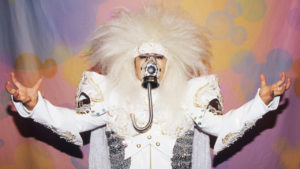
Akira Hokuto is perhaps one of the most unappreciated wrestlers of her time whose legacy has benefitted tremendously from tape-trading and her matches being uploaded to the internet. Most people to discover 1990s AJW usually do so by way of spot queen Manami Toyota, legendary monster Aja Kong, or literal Oriental Bitches Etsuko Mita and Mima Shimoda. But when it comes to exuding star power, overcoming debilitating injuries, and being an absolute menace in the ring, few come close to Hokuto. Though her initial in-ring career was short, barely reaching a full ten years, she reached incredible heights that either rivaled or in some ways surpassed what her more famous predecessors achieved. She is the woman who infamously took a second-rope Tombstone Piledriver, broke her neck, and continued the match holding her head in place with one hand. In another instance she botched a dive, tore her leg open, and refused medical intervention because she wanted to finish the match. She even had AJW’s 1994 Tokyo Dome show built around her teasing a potential retirement. In a time when female audiences were dwindling Hokuto was one of the main forces behind joshi’s shift towards male viewers and her wrestling moving away from being segregated by the audience’s gender.
However, Akira Hokuto’s reputation isn’t as rosy as all that. In the ring she was incredible. But backstage was…another story. Stories have gone around of Hokuto being selfish and hard to deal with backstage. Jabroniville, BoD’s resident joshi expert, once summarized her reputation as her being “NOT FUN to have around at times”. That’s where these books come in: help understand reports and rumors with a bit more context from the woman herself.
She was one of those wrestlers who achieved wider appeal…and her story is one of the most cathartic that I’ve ever read. This is especially true since Hokuto overcame not just injuries and the brutal lifestyle of women’s professional wrestler, but she also endured such a harsh and depressing childhood that it makes the sight of her actually smiling all the more meaningful.
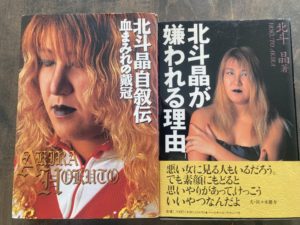
Akira Hokuto Autobiography: Blood Soaked Coronation, published August 1, 1994; and
Why Akira Hokuto Is Hated, published December 20, 1995
BLOODSOAKED is Hokuto’s primary autobiography and covers everything up to mid-1994 while HATED focuses more on her personal life leading up to her marriage to Kensuke Sasaki and includes a few career anecdotes as well. I may also include some text from supplementary joshi resources as well if needed.
Part 1: Life Before Wrestling
In BLOODSOAKED Hokuto opens with the recognition that…she was not wanted when she was born. Well, fuck, there’s a kick to the stomach to set the tone. One of her earliest memories is of a school assignment about where her name came from. Though she recalls rarely doing her homework as a child because she convinced herself she’d become an amazing person, this particular assignment sparked an unusual curiosity in her. So she asks her mother which leads to a long story about Hokuto’s family. Her real last name is Uno and the Uno family hail from a small place called Miwanoye, itself in a small area called Yoshikawa in the Kitakatsushika district of Saitama prefecture. The Unos were farmers, having tended to the same plot of farmland for twelve generations. There’s was a big family with grandparents and great-grandparents all living together. Her mother, Matsue, married the oldest Uno son when she was eighteen and two years later their first child, a daughter named Noriko, was born. Matsue became pregnant again soon afterwards but because she had to tend the farmland she “had to give up this child”. In addition, Matsue didn’t get along with her mother-in-law, which continued until well after the next child was born. After some effort and some added vitamins in her diet, Matsue soon became pregnant for a third time and on July 13, 1967 a second child was born.
A second daughter.
This instantly caused more hardship on Matsue since the Uno family needed a boy. Not only for all the hard toils of daily farm work, but because only male heirs could inherit the family land. Since they already had one daughter, a second girl was not needed. As such, no one celebrated this second daughter’s birth and Matsue didn’t even return to her home right away, instead going to her own parents’ home. Since there was no one to celebrate or even acknowledge this second daughter’s birth, for a few days she was known as “Nameless Gonbei” (APOD: this roughly translates into English as “John Doe” with a decidedly masculine undertone and implies someone is so unimportant that they do not warrant enough attention to need a name). Eventually Matsue thinks up a name and, recalling someone from her own school days – someone smart, beautiful, and well-liked – she names her daughter “Hisako” (APOD: for consistency’s sake I’ll refer to her as “Hisako” until she adopts her ring name). A month later Matsue returned to the Uno household with Hisako, who from then on decides to make it her life’s goal of proving wrong everyone who wasn’t happy about her birth.
From there Hisako pivots to another early childhood memory. She openly admits to being selfish even as a child, going so far as to call herself twisted and admit that if there were two of the same thing she’d want the one that wasn’t given to her (APOD: though this is presented as completely separate from the circumstances of her birth, I doubt that learning the truth of her origin didn’t affect her personality in some way). Hisako admits to being this way even in the present as an adult. She describes her daily life with her big family as “a storm of fists” but plainly admits that she did things to deserve those fists. She flat out admits to “hating her whole family”, noting that only her older sister was spoiled or given any attention. Incidentally, older Noriko had the complete opposite personality and was prone to crying with little effort from her younger sister. As a result Hisako would only bully Noriko more, then more tears would flow, and Hisako would face corporal punishment. Rinse and repeat.
At that time the only person who treated both girls equally was her “grandpa”, but talking about him leads down a strange path of bizarre genealogy. When she was still a kid, Hisako observed that her grandma looked much older than her grandpa. When she asked this aloud she was frantically told not to say anything about this within earshot. It turns out her grandpa wasn’t her grandpa. Her real grandfather was killed in the Greater East Asia War (APOD: what Japanese people called the Sino-Japanese conflicts and the Japanese part of World War II). His wife, Hisako’s grandmother, was left behind with the grandfather’s second son, Kanematsu. Since the father was the head of the family, if he died then anyone surviving like a wife/widow and children were nothing more than strangers. To save them from a life of poverty, this young son, once he grew up and finished middle school, married the woman who had married his now-deceased father. Hisako, now older, suspects that this younger son made a huge personal sacrifice so that his remaining family wouldn’t be rendered destitute (APOD: this story leaves a lot of unanswered questions, especially as it pertains to who sired whom and whatnot; all Hisako notes on this is that this other man is somehow related to her by blood but even in her mind it’s all fuzzy).
Back at her home, Hisako recalls both her and her mother being bullied by her grandmother and great-grandmother, likely over Hisako being born female. Since her mother had to get up early to work the fields, Hisako’s school meals were usually made by her eighty-year-old hard-of-hearing great-grandmother Yone-ba-sama who often made mistakes that made it harder for Hisako to fit in while attending kindergarten. One of Hisako’s most enduring negative childhood memories concerns her bento box and how she always compared what she’d be served for school with her closest friend, a girl named Naomi. On many occasions Hisako was made to feel self-conscious over not having the same style of food or even the same quantity, though it wasn’t out of poverty or lack of access. In Hisako’s mind she asked her great-grandmother to pack her specific things in her bento, especially when certain trendy or faddish things became popular in her school and she wanted to feel included like everyone else. On one particularly jarring occasion Hisako begged and pleaded repeatedly for Yone-ba-sama to include something called “furikake” (which involves, among other things, dried fish), only for her bento to instead be filled to the brim with locusts simmered in soy sauce. They looked the same as how Hisako had described to her, but the elderly woman gave her great-granddaughter something so outlandishly different that she made up a lie about a stomachache and refused to eat her lunch that day. Incidentally, Yone-ba-sama died two years later but this incident remains Hisako’s strongest memory of that woman.
As an aside Hisako loved animals and was especially fond of the cows her family owned. According to her these weren’t working animals but pets and Hisako witnessed the cow, named “Bee-chan” giving birth to a calf, whom she named “little Bee-chan”. When this little calf was born Hisako loved him more than anyone else in her family and found him even cuter than the family dog. Sadly this joy didn’t last long since both the calf was sold for ¥100,000, a small fortune in those days. This was Hisako’s first experience with loss and notes that even in the present when she sees cows she calls them “Bee-chan”. She also notes that one of her earliest motivations for wanting to become rich was to buy little Bee-chan back.”
Like the male wrestlers covered previously, Hisako had to walk to and from school every day. In her case it was an hour each way, carrying a backpack bigger than her whole back. She spent a lot of time in nature looking for insects, catching fish, and climbing trees, all of which trained her reflexes and improved her stamina.
Though she recalls being a “cute kid” in elementary school despite her rough life at home, Hisako notes that her personality changed significantly once she entered junior high school. In her case, she ended up being a delinquent. Despite trying to motivate herself to focus, Hisako hated studying and soon found herself falling behind. She was also restless and hated the idea of sitting in one spot for more than an hour. These traits, coupled with her difficult life at home, made it easy for Hisako to fall in with the wrong crowd and so she found herself easily swayed by the delinquent (“sukeban”) culture sweeping Japan at the time. (APOD: Anyone who has watched the Netflix series “The Queen of Villains” about Dump Matsumoto knows what this looks like as Matsumoto’s little sister fell into this culture at one point). And yet interestingly Hisako notes that even in her delinquent group there was a hierarchy system and since she was bigger she could control smaller kids and made them do what she wanted.
Wanting to improve her reputation, Hisako found herself engaging in “taiman”, or fights with other delinquent girls. She describes this as stereotypical catfighting with slapping, kicking, and hair-pulling, with the rewards being cigarettes and “thinner” (APOD: paint thinner?). This continued for two years only to end when Hisako fell in love with a boy on the school baseball team in what reads as something ripped straight out of a Slice-of-Life anime: a teenage girl swooning over a boy she went to elementary school with but never noticed until now. Determined to get him to “not dislike her”, Hisako joined her school’s softball club just to see him train. Then came Valentine’s Day…and another twist. It turns out that both Hisako and another girl had crushed on – and made homemade chocolates for – the same guy. Somehow Hisako is asked to hand chocolates to him on the other girl’s behalf as well. Also, word had spread that this guy knew he had many girls after him and would only accept chocolates from the one he loved, and after Hisako gave him both her own and the other girls, he accepted the other girl’s. Looking back she has mixed feelings about this but notes it was an important point in her maturing.
As graduation approached, Hisako found herself struggling on a career path. Since she was also a member of the track & field club she knew she had tremendous speed. This enabled her to play center in softball and she broke records at her school for her performances. However soon another anxiety emerged as she was the only one from her school to attend a different high school and she quickly concluded that she probably wouldn’t see many of those other people ever again. Still, once in high school she tried to make the best of things.
With her team having the sole goal of reaching nationals, Hisako had to get up at 5am every day, seven days a week, and commute two hours by train to her school for softball practice. There she and her fellow players endured strenuous practice which included sliding practice that would see her and her peers bleed from their thighs from the friction with the ground. One instance of sliding practice goes awry for Hisako as she injures the bone at the base of her left thigh and ankle. This injury sidelined her from practice but Hisako used this as an opportunity to socialize and enjoy herself, something she hardly did up to that point. Eventually she started running out of money and needed a way to supplement her new lifestyle. When she was younger and with the delinquents she would shoplift but now in her new environment, against her school’s strict rules, Hisako got a part-time job.
Around the same time she also had a friend named “Ecchan” who, unlike most of her friend group, didn’t go to discoes or enjoy all the flashy parts of being young. When Hisako confronts Ecchan about why she’s so (allegedly) unsociable, Ecchan responds by inviting Hisako to accompany her to watch pro-wrestling at Korakuen Hall. Hisako initially dismissed pro-wrestling as lame but she sees Ecchan’s passion when she walks about it. And yet Ecchan was the only one of her friends who watched wrestling and after seeing Ecchan so enthusiastic about it, Hisako makes an about-face and decides to check it out with her.
On their way Ecchan talked about all her favorite wrestlers including Kuniaki Kobayashi and Jumbo Tsuruta. Then once the show started, Hisako found herself being hypnotized by the action as it unfolded:
“Right after the match began, I still didn’t really get it, but when I heard the incredible sound of people being thrown and slammed into the ring, I felt both fear and intensity. At first, the audience watched in silence, but gradually, each person started shouting in their own way. If I had to sum it up in one word, I’d say it was stress relief. Even if they were cheering for different wrestlers, everyone here was united within the circle of pro wrestling. That’s how it felt. I could tell I was gradually getting drawn into that atmosphere.
Several matches went by, and then Riki Choshu and Akira Maeda, whose names I knew, entered separately. It was a tag match, but Choshu and Maeda faced off. Even though I only knew three wrestlers, two of them appeared at once, and just watching made me nervous. Compared to the first match, it was on a much bigger scale, and even someone like me, who knew nothing about pro wrestling, could tell from the cheers that these wrestlers were stars. Choshu and Maeda seemed to be real stars.
As the match went on, my eyes kept following Maeda. Whether he was fighting in the ring or standing in the corner, I felt like if I looked away, I’d miss something important. He was the kind of wrestler who seemed to radiate an incredible aura from his whole body. I became absorbed in Akira Maeda’s wrestling, and ended up just staring blankly, unable to even cheer.
When Choshu locked Maeda in the Scorpion Deathlock, the intensity of that moment and the tremendous roar from the crowd snapped me out of it. I had never seen a man suffering so much before. Watching Maeda grit his teeth and endure, instead of thinking “escape to the ropes,” I found myself thinking, “It’s enough already, just give up.”
Maeda managed to reach the ropes once, but he was dragged back to the center of the ring and put in the same hold again. Watching Maeda suffer even more than before, I started to wonder less about who would win or lose, and more about why he wouldn’t give up, why he fought so hard, and what was at the end of pro wrestling. That’s what I found myself thinking. It was a world I couldn’t understand. The image of Maeda’s face, suffering in the Scorpion Deathlock, was burned into my mind, and the first pro wrestling match I ever saw left behind a kind of sadness in my heart that I couldn’t quite explain.
It was not a sad kind of pain. Ever since I saw that face enduring suffering, Akira Maeda and pro wrestling had become something I could never erase from the bottom of my heart. However, at that time, I still hadn’t even considered wanting to become a pro wrestler myself. I just hated the way I used to look at pro wrestling as something uncool.” – Hisako Uno/Akira Hokuto
After this Hisako begins attending wrestling shows regularly but also finds herself anxious over her future. Her grades were poor and she had lost her passion for softball. Her only despite from this anxiety was watching Akira Maeda wrestle. Then one day she and Ecchan ran from their school to NJPW’s dojo in Todoroki in the hopes of catching some of the wrestlers after their training session. Upon arrival Ecchan was able to talk to her favorite Kobayashi but Maeda wasn’t there. Then out of nowhere Kobayashi noticed Hisako spacing out and told her that she had a good physique and she should consider becoming a women’s pro-wrestler. Just like that Kuniaki Kobayashi had lit the spark that would decide Hisako Uno’s future.
Hisako didn’t know anything about women’s pro-wrestling so she relied on Ecchan and her little brother to collect info and contact AJW’s office. Upon arriving she sees many other similarly-aged girls already there, whom she initially presumes to be groupies for the wrestlers. One of these girls approaches Hisako and explains the process of becoming a trainee: pay ¥3,000 admission and then ¥500 per session and you can become a trainee. Hisako had more than enough and accepted.
But there remained some hurdles. Hisako’s parents weren’t angry, hostile, or immediately protesting as she expected. School was another matter. If word got out that she was training she’d be expelled and that would carry with her for the rest of her life. But Hisako wanted this dream and pursued it regardless of cost. So when she tells her family she’s dropping out of school, she gets into a monumental fight with her grandfather. He and Hisako get physical, fists throwing from both sides. Then in her anger Hisako shouted, “Shut up, you old bastard. You’re not even my real grandfather!”
In a moment of self-reflection Hisako finds herself incredibly remorseful over her words. It is her, not someone else, who shatters the peace in her household. At this point in time her family life has made a complete 180 with her parents, older sister, younger sister, and grandfather, all living together happily with her feeling, in a word, “blessed”, to have them. Ultimately neither Hisako nor her grandfather ever apologized for that incident to each other yet Hisako uses this book as a vehicle to express her hatred towards herself for letting things go that far and to apologize to her grandfather for what she said.
APOD: This was an absolute rollercoaster of a story that kept going and going. Before I knew it I had written almost 4,000 words on this part of Hokuto’s life and there’s barely and wrestling involved here, that’s how much she was able to suck me in with the stories she told of her pre-wrestling life. Her early life was one of the most sobering I’ve ever read and written about. Her childhood was horrible: I felt an overwhelming sense of pity and sadness for Hokuto knowing just how bad things were from her first breath. It’s a truly awful thing for any child to know they were/are not wanted. Worse was that there was constant verbal and physical abuse from within the household that left Hisako lonely and unloved, two things no child should ever experience. Thankfully things got better with time yet Hokuto seemed to be doomed to an uncertain future had that one friend led her down the path of professional wrestling.
Strangely Hokuto completely omits any mention of her being a fan of Bull Nakano at any point and presents her introduction to pro-wrestling as a product of happenstance as opposed to something that had been cultivated for some time. Maybe the fact that this book was published in 1994 when Hokuto was on her (at the time) retirement tour might explain a need to kayfabe her fandom but it’s still an important omission. Hopefully there will be more explanation in the next session which will see Akira Hokuto begin her wrestling training in earnest.
As always, thanks for reading.