

5-Star BOOK Reviews: Akira Hokuto’s Books, Part IX
By Alex Podgorski on 1 May 2026
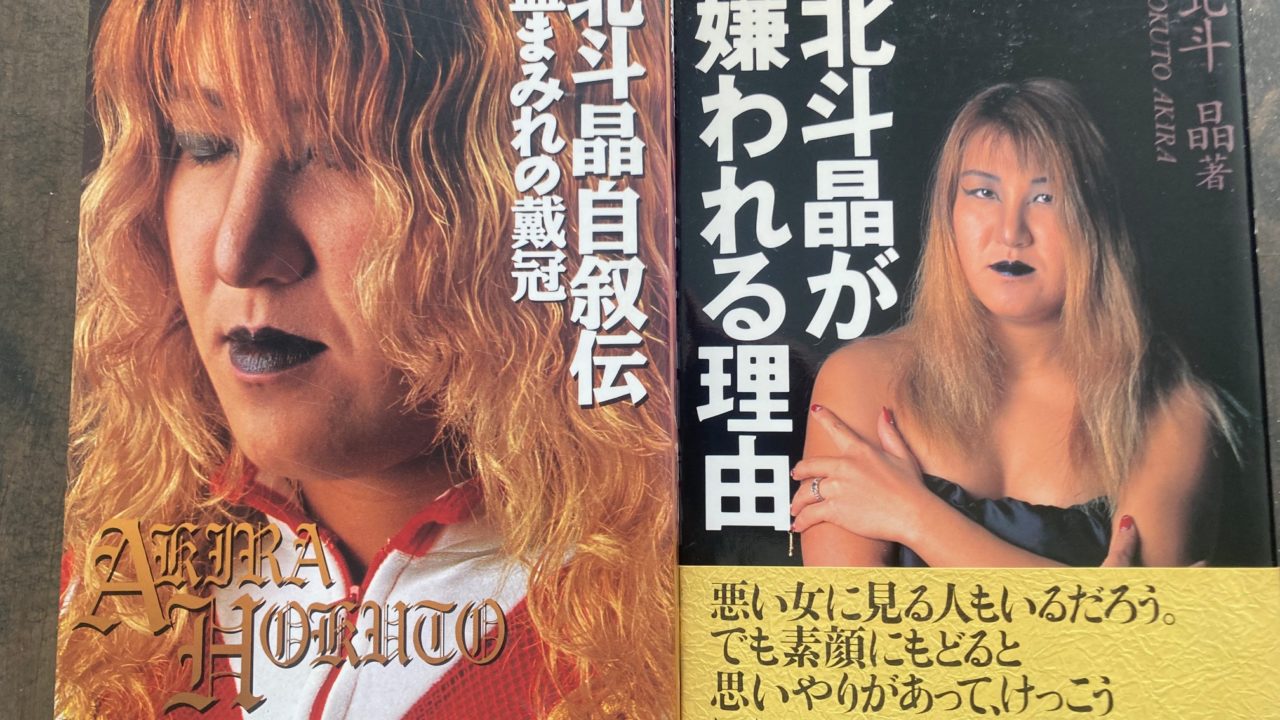
Welcome back to my coverage of Akira Hokuto’s books. This will be a shorter section as it will conclude Hokuto’s 1994 autobiography BLOOD SOAKED CORONATION. There are a few loose ends that she tries to tie up here, including another tour of Mexico that sees her don a mask and new persona, a brief encounter with one of the first pro wrestlers in Japan, and what is once again framed as her retirement match only for plans to change again. I swear, either Hokuto herself or someone in her immediate orbit must be a Terry Funk mark because talks about retirement almost as much as he did. But even with this book closing on yet another big match, this is far from the end with her since there’s another book to cover once this one concludes.
You can read part 1 here, part 2 here, part 3 here, part 4 here, part 5 here, part 6 here, part 7 here, and part 8 here.
Part 9: “Queen” Akira Hokuto
After St. Battle Final and the AJW awards ceremony, Hokuto takes a vacation to Saipan for an undisclosed amount of time. Upon returning to Japan she finds that President Kunimatsu and others at the AJW office had been bombarded with calls and letters protesting Hokuto’s departure. In response, she and Kunimatsu lay out a plan for a legitimate retirement to take place towards the end of 1994. Her initial plan is to retire on March 27th at the Yokohama Arena; however, before that decision can be finalized she learns of subsequent AJW shows at the Nippon Budokan and the Tokyo Dome. The office recommends she retire at the Tokyo Dome as this would be a fitting opportunity given AJW’s first Dome show. Hokuto uses this book as an opportunity to speak to the wrestling press that Akira Hokuto* would only participate on these limited dates in Japan. That asterisk is there because she works around this by embarking on a tour of Mexico and wrestles under a different name: either Reina Jubuki or Reina Fubuki (APOD: I’ve seen both version used in various sources. “Jubuki” is the one used in many online archives but “Fubuki” is the one that actually makes sense because “Reina” means “Queen” in Spanish and “Fubuki” means “Blizzard/Snowstorm” in Japanese while “Jubuki” is meaningless. In other words, Hokuto wrestles in Mexico as “Blizzard Queen” for several months). Hokuto returns to Mexico with a purpose: rather than adapt to the Mexican style, this time she wants to raise the level of Mexican wrestling with her own hands. As part of this goal, Hokuto finds herself arguing with CMLL officials over her choice of techniques. Using her regular repertoire would leave fans stunned silent and doctors would warn her that her moves are dangerous, even some of the less head-spiky ones like the powerbomb and German suplexes. In response, Hokuto would tell them, “No importa, soy japonesa (It doesn’t matter, I’m Japanese).” Hokuto calls bullshit on these warnings about safety because she sees men using powerbombs on a regular basis. She concludes that those moves are banned specifically for women because from her perspective women in Mexico are inferior to men and this extends to wrestling. Her perception of Mexican wrestling is that their ideal is for women to be flower girls and nothing else. Hokuto uses her situation to try and change this perception. It is also during this time that Mexican wrestling magazines start referring to her as “The Dangerous Queen”.
Hokuto wrestles three matches in CMLL in February and then returns to Japan in time for the big Yokohama show, Wrestling Queendom. While in Mexico fan voting decides her match: Aja Kong & Bull Nakano versus Akira Hokuto & Shinobu Kandori. Since it’s decided by fan vote, there’s no backing out or changing it. Hokuto approaches this match as a war on three fronts: she’ll have to deal with Aja Kong whom she can’t read; Bull Nakano who might erupt like a volcano at any moment; and Shinobu Kandori, because they still hate each other. Hokuto shows more of her back-and-forth indecisiveness: she credits Kandori with helping create the wrestler Akira Hokuto but at the same time she thinks that had they never crossed paths she’d be able to wrestle a bit longer.
Two weeks before the Yokohama show Hokuto embarks on a tour of South Korea where she and three other joshis have a magazine interview with Kintaru Ohki, a.k.a. Kim Duk, a veteran of the days of Giant Baba and Antonio Inoki. She sees Ohki dealing with the aftereffects of wrestling, including regular headaches from his use of the head-butt and a leg so swollen it looks like an elephant’s. As she prepares to leave Ohki asks Hokuto to sign a photo of him in his younger days. As a parting joke, Ohki suggests that Hokuto’s name should’ve instead been “Hokuto Shichisei (the Big Dipper)”.
March 27th, Wrestle Queendom. Hokuto has her own private dressing room which she considers a sentimental gesture as it symbolizes her increasing separation from the rest of AJW’s women. Once all four women are in the ring, Aja Kong taunts Hokuto telling her she won’t get to hog all of the glory for herself. She puts Kong over once again, calling herself a small-time wrestler compared to Aja. Hokuto puts a lot of emphasis on the small details as part of the story, like how Bull & Aja were standing together as a united front in their corner while Kandori was off doing her own thing when Hokuto wanted to stand with her side-by-side. She recalls a lot more of this match than others, like how Kandori was constantly ignoring her (kayfabe, of course). In response, Hokuto’s idea of a tag is to slap Kandori’s face, which apparently counts as tagging in. Her cattiness is so entertaining. There was also another story being told in this match, at least in Hokuto’s mind: this match was a reflection on Hokuto’s decision-making. She chose to tag with Kandori and wanted to prove that was the right decision. So for a long time as Bull & Aja work them over this idea of regret floats around in Hokuto’s mind and is expressed in Hokuto & Kandori taking such an extended beating. In a perverse sort of messaging, Hokuto gets into a stiff strike exchange with Aja which is meant to send a message to Kandori, who is still very much doing her own thing outside the framework of this match. Eventually Kandori does come around and works with Hokuto to win the match, though it’s more of a case of cooperation by circumstance than a true unified front. This is further shown when Hokuto and Kandori “celebrate” post-match: Hokuto offers her hand, but not to say “thank you” but “our business together is done”. (APOD: You can watch this match here. It’s an outstanding match that does the “partners that hate each other” gimmick so well that the language barrier proves meaningless). And with that, BLOOD SOAKED CORONATION comes to an end.
Review: I loved reading this book and I hope you enjoyed these summaries just as much. Yes there were some details that were kayfabed, exaggerated, or omitted. Yet even if these personal anecdotes are all written to hype something up – which is likely given that Big Egg Wrestling Universe was only three months away – there was still enough in here to make for a compelling read. To me Hokuto comes across as a female Shawn Michaels: someone who knows of their own personal weaknesses yet doesn’t shy away from discussing how those weaknesses affected them and those around them. Hokuto talking about her inner struggles and her emotions made this much more relatable as well: even through the veil of pro wrestling she came across as someone from an ordinary background thrust into an exceptional world. If we compare this autobiography to the other “main” ones covered thus far – Kawada’s 2003 book My Own Royal Road, Kobashi’s 1999 book Fist, Misawa’s 2000 book Departure, Taue’s 2023 book Aloof & Confident, Fuchi’s 2022 book Royal Road Blues, and the 2020 Tsuruta book Eternal Strongest Champion – only Kobashi’s has as much honesty and detail. What I appreciated most here is, despite a lot of kayfabe throughout, Hokuto remained self-aware about her physical and emotional struggles. She knew she acted up to management, she knew she had a knack for unapproved post-match verbal appeals, and she knew that she acted selfishly in a business and a country that puts the collective ahead of the individual. Even if these actions don’t paint her in the most positive light, at least they made her more believable in the very much unbelievable world of pro wrestling.
Final Rating: *****
As always, thanks for reading. The next section will look at the first part of Hokuto’s second book which addresses why she is so hated.