

5-Star BOOK Reviews: Akira Hokuto’s Books, Part V
By Alex Podgorski on 2 April 2026
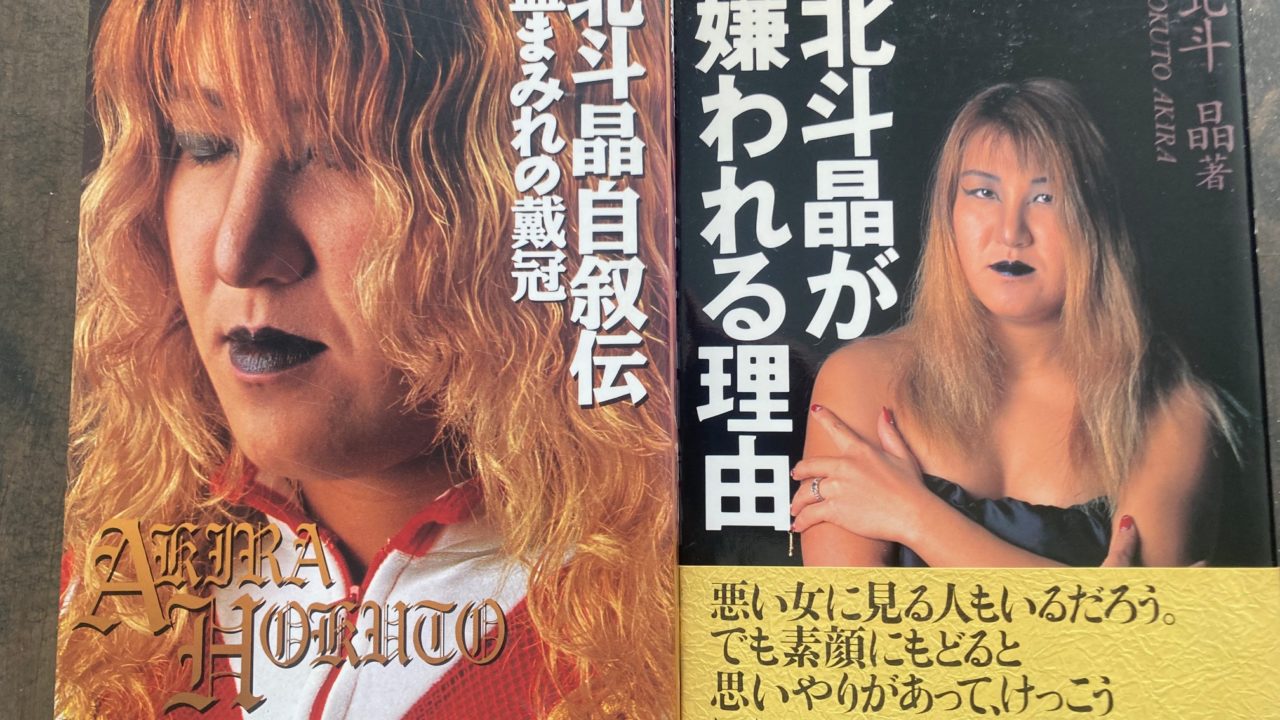
Welcome back to my coverage of Akira Hokuto’s books. This next section will cover lots of ground, though not necessarily by my choice. So far Hokuto has been fairly consistent with covering her life and career but this next section is where things get murky. Hokuto leaves out a lot in this next part so we’ll go from late 1987 to early 1992. This will be the last section in which we look at Akira Hokuto’s books from the dual perspectives of pre-gimmick Hisako and Hokuto since this is where the two truly become one. Here we’ll go over Hisako Uno’s return from her near-fatal neck injury, how she accepted the company’s initial response to her pleas to return, how she eventually made her way back into the ring, and how she transformed into the wrestler known as Akira Hokuto.
You can read part 1 here, part 2 here, part 3 here, and part 4 here.
Part 5: Hisako Uno is dead; long live Akira Hokuto
Hisako returns to AJW fully aware that she won’t be able to return right away. Upon entering the office she feels uneasy amidst management’s pitying stares. Then Chairman Matsunaga tries setting her own easy and tells her that the company is too scared to use her. He explains that the company admires her dedication but they’re worried her getting back into the ring would create “a social issue”. In other words, they’re afraid of any bad press she would bring if something happened.
Recalling his pale face on the day he told her Maki Sato died, Hisako understands his position entirely. However, Hokuto looks at this situation retrospectively and her maturity over the situation comes from her present-day voice (i.e. in 1994). 1987 Hisako thinks differently (read: selfishly) and claims that she’d undergo the same kinds of physical and mental agony and she’d endured at the hospital if it meant wrestling again. She proclaims that those who haven’t experienced death or been as close to it as her shouldn’t talk about it and reaffirms her pledge to step into the ring even if doing so puts her life on the line.
Taking a wider perspective, Hisako recalls the rumors that circulated upon her return. Some of her peers called her stupid for wanting to wrestle. Some of them protest and vow to quit if she returns. Others demand to not be booked against her. Hearing these things wound Hisako more than any injury. Even when stopping by and not committing to anything physical, Hisako recalls seeing more and more people, even her fellow trainees or peers once close to her, now turning away from her and not even acknowledging her. That is, except one: Bull Nakano, who encouraged her to “hang in there”. Nakano’s neutral language here is intentional: Hisako explains it as Nakano trying to avoid more seniors’ eyes on her. To help her friend, Nakano gifts Hisako a dachshund puppy which she names “Gajira”. Hisako vows to someday ride the zenko bus with Gajira/Gacchan, just like the seniors with their dogs.
As time goes on Hisako keeps visiting AJW’s office asking for them to reconsider. Eventually the Chairman decides to make her a coach so that she could earn a reasonable living and have enough money to feed Gajira. Kanzaki, who visited Hisako in hospital, would be paired with her and they’d train rookies together with Hisako doing verbal explanations and Kanzaki doing them physically. This path allows Hisako to remain associated with wrestling and gives her faint hope that, someday, she’ll be able to re-enter the ring.
“It may be a dangerous path. But a road with no obstacles, where nothing ever changes no matter how far you walk, is boring. I think the dangerous road where you don’t know what will happen next is more exciting. Of course, it’s so dangerous that I might lose my life. Even so, I have no doubt that the path I chose is the right one.” – Akira Hokuto
As part of this determination, Hisako starts training in the dojo at night. As a trainer she is given a key to the dojo and by being alone she doesn’t have to worry about being seen as a “tragic heroine” by her peers. Initially she starts with basic things like jump rope and push-ups to rebuild her muscles. Then, over time, she overcomes her fears and practices neck bridges without issue. Around this time the hospital asks her for a follow-up visit and when she asks Chairman Matsunaga once again to wrestle he tells her she needs approval from the hospital.
Hisako visits the same hospital and, after seeing more or less complete recovery in her scans and X-rays, she asks once again for the doctor’s permission to do wrestling. However, once again he reiterates to her that HIS license and career would be on the line if something happened to her. Despite her usual persistence, Hisako accepts his words and returns home full of despair, the despair of “simply living”.
Hisako falls into a brooding depression over her life turning ordinary and mundane. At times she would forget to play with Gajira and even shouts at him when he barks. She recognizes that this made her “the worst kind of person” yet when she cries alone in her apartment, Gajira would paw at her as if to console her. She’s overcome with the harsh reality of her crushed dream, that she couldn’t ride the AJW bus on tour with her dog. The fact that some of the trainees and other wrestlers “envying” her for her not having to wrestle further worsens her depression.
Then one day Hisako is invited to a show in Osaka and, after initial reluctance, decides to go. She arrives at the venue in a taxi alongside the company president and they are swarmed by fans on arrival. Hisako initially thinks these fans are for the chairman when in reality they’re there for HER! This is the first time Hisako experiences such support and the whole thing leaves her confused. Then Chairman Matsunaga tells her to collect 10,000 signatures. If she does, he’ll reconsider her proposal to wrestle. Hisako hurries over to a nearby Lawson and picks up a notebook. Before the night’s over, she obtains 300 signatures.
Unable to accompany AJW on regional tours due to her training schedule, Hisako recruits a fan from Tokyo who basically starts a word-of-mouth campaign to get her to return. Then other fans copy her, get their own notebooks, and start collecting signatures. Even on rainy days they stand in front of venues collecting signatures. In some cases she suspects the signees didn’t even know who she was yet they signed because they were moved by these fans’ passion, which far eclipsed her own.
Chairman Matsunaga asks her for 10,000 signatures. In the end, Hisako and her network of fans collect 80,000!
Stunned, the Chairman asks her to get her parents to approve as well. However this is easy because her parents support her wholeheartedly, despite her harrowing experience with a broken neck.
“If she says she wants to do it, there’s no point in stopping her, and if she dies, there’s no helping it. President, do whatever you want with her—boil her, roast her, kill her, as you please.” – Hisako Uno’s parents to AJW management
After all of this, management decides to reinstate Hisako on the active roster…but with the caveat that she only work with her peers and juniors since no seniors want to work with her. Hokuto’s first match back takes place on December 6, 1987 in Korkauen Hall as part of an event called “Future Battle” which focuses on up-and-coming stars. Uno gets a huge pop from the crowd. Hisako describes experiencing the sights and sounds of entering the ring as her “coming back to life”.
(APOD: Despite all of this, there remains the unanswered question of that doctor not wanting to risk his professional career and allow Hisako to wrestle. Whether this matter was resolved privately without Hisako’s knowledge or just an abandoned plot thread by Hisako as she returns to her wrestling life is unknown).
After winning her return match, Hisako takes stock of her surroundings and realizes that many girls had left while she was recovering. Of her group, only six others besides her remain. Because of her timing and slow recovery, Mitsuko Nishiwaki replaces her as Yumiko Hotta’s partner as the “New Crush Gals” and are rebranded as “Fire Jets”. Their popularity – and remnants of the original Crush Gals’ popularity – leads to a tour of Thailand. There, Hisako confides in her roommate Mika Suzuki (the future Suzuka Minami) of all her struggles while Suzuki tells her how she was being left behind from the Fire Jets despite being so close to Hotta and Nishiwaki. This deep conversation inspires the two women to work hard together and they end up having heated matches during that tour of Thailand.
Within days Hisako & Suzuki are approached by AJW management with the prospect of releasing a record. This is a tradition that goes back to the original Beauty Pair, possibly even earlier, of women’s wrestling stars being mixed with pop elements to improve their crossover appeal. In response, Hisako’s attention shifting away from the ring towards singing, dancing, and other “star” activities. Through these activities Hisako & Suzuki grow closer and it’s through these experiences that Hisako reflects on their contrasting personalities. Specifically, Hisako points out how she still lacked maturity compared to Minami and still had a tendency to throw tantrums until she got her way while Minami acted quiet and almost motherly in comparison. Because they were so different from one another, management struggles to pick a name for them. In response, Hisako reaches out to their fans to decide. After getting tons of different responses via postcard, they decide on “Marine Wolves”. Hisako hates this name because to her it sounds meaningless but since her fans had come up with it she decides to go along with it. But that’s not the only suggestion that comes via postcard.
Around the same time there is talk of giving both girls new individual ring names. Suzuki is renamed Suzuka Minami while Hisako’s renaming process takes a bit longer. Hisako recalls memories of her time in high school and her older sister calling her “Akira” because she looked like Akira Maeda and some fans would call her “Akira” during her rookie matches. However, this wasn’t the initial decision. Because Hisako had short hair and looked a bit masculine, Rossy Ogawa suggests she be given the name “晶” which is pronounced “Shou”, as her first name. Then Rossy takes elements from Ultraman Ace and notes how Minami and Hokuto (south and north) form to make Ultraman. So her initial name is Shou Hokuto. However, since enough fans still called her “Akira” she keeps that first name going forward, and thus is reborn as Akira Hokuto. (APOD: This is another one of those linguistic differences that I don’t think fully translates into English, at least as far as writing is concerned. I checked and the kanji “晶” does indeed mean “Shou” yet in Hokuto’s online biographies her “Akira” is written with this kanji and not 明, which is the standard kanji for “Akira” and is seen with wrestlers like Maeda and Taue. In any case, this name would have different meanings: “Shou Hokuto” could roughly be translated to mean “Northern sparkle” or “Crystal of the North”. Meanwhile, the easiest translation of “Akira Hokuto” into English would be “Northern Light(s)”. In one of his books, Rossy Ogawa claims that naming these two women “North” and “South” was meant to be a play on their personalities).
Hokuto’s first performance is just that: a performance and not a match. Her first action reborn under this new persona is a song and dance routine as she tries to embrace her new position as AJW’s next idol star. That said, she recognizes that she sucks at singing and she’s surprised that she could even sing in front of the crowd.
An unknown amount of times goes by with her spending her time singing and pop star work. So at this time she’s a wrestler on paper but not in practice, with far fewer recorded matches taking place between 1988 and 1990. In 1989 The Marine Wolves beat the Fire Jets to win the vacant WWWA World Tag Team Championships in a match that helps Hokuto accept the fact that Yumiko Hotta, who was once positioned as her partner, has now embarked on her own path. (APOD: Incidentally, Hokuto omits a pretty important moment, that being that she and Minami teamed together against the original Crush Gals on Chigusa Nagayo’s retirement show. This might be an intentional omission given Hokuto’s established theme of being selfish or self-centered, but it’s kinda hard to ignore any direct involvement with the Crush Gals since they’re arguably THE biggest women’s wrestling stars of all time).
This moment in the spotlight is short-lived with the Marine Wolves and the Fire Jets not drawing as much as expected. Hokuto notices management’s sudden and heavy pivot towards the class of 1987, composed of Etsuko Mita, Mima Shimoda, Toshiyo Yamada, and Manami Toyota (APOD: quite possibly the most impressive and vaunted quartet of women’s wrestlers in decades). This pivot leaves Hokuto feeling frivolous and stuck doing pointless activities. She feels like she had become a “small-time wrestler” despite always having much greater ambitions. Though she’s thankful to AJW for giving her the opportunity, she doesn’t feel like a wrestler but as a celebrity, which isn’t what she wants and can’t become because she knows she can’t become “like Crush” no matter what management does with her.
By this point in her career Hokuto’s in her eighth year as a pro, a point when most women consider retirement. She, however, starts looking at the possibility of becoming a singles star or the possibility of becoming a heel. To achieve this, she dissolves the Marine Wolves but doesn’t put any blame on Minami for it. She concludes that they were simply two different personalities drawn together by shared loneliness and that, by moving away from Minami, she can have her own match framework. Scanning the landscape Hokuto notices Jungle Jack (Aja Kong & Bison Kimura) making a name for themselves in Universal and appealing to men (APOD: Universal Lucha Libre existed from 1990 to 1995 and had a talent exchange with AJW. I’ve seen it mentioned in several other Japanese wrestling books how Kong in particular shined in Universal since she was no longer constrained by the AJW practice of preventing heels from outshining babyfaces. It was her activities in Universal that led to men following her back to AJW and then those men becoming entrenched AJW fans that for all intents and purposes replaces the screaming teenage girls who watched AJW during the 80s).
Another time skip occurs, this time all the way to the 1991 Japan Grand Prix (APOD: This also skips Hokuto’s other big injury which took place during the 1990 JGP tournament. she faced Toyota in the first round but the match was stopped because Hokuto smashed her knee into the ringside barricade while executing a plancha. In the process she tore her knee open which left her unable to walk yet she still tried to continue the match. The official refused to let her continue and she was removed from the tournament thereafter. This injury has been added to the ~LORE~ around Hokuto yet judging by the fact that she was wrestling a month later it might look and sound more gruesome than it really was). Anyways, in the 1991 tournament Hokuto finds the opportunity to turn heel and teams with Bull Nakano against Jungle Jack. They win but not without paying a high price because Jungle Jack cut some of Hokuto’s hair. Hokuto describes a fleeting moment in which she contemplates retirement, having tasted what it feels like to be a heel. Then she approaches president Jimmy Kayama with the resolve to quit but when she gets in front of him she can’t get the words out. Instead she talks with “Manager Ogawa” and credits him with the creation of Akira Hokuto and despite him being a good sounding board who can weigh pros and cons, in the end Hokuto can’t actually speak the words “I want to quit”.
Six months pass. Hokuto finds herself unmotivated and going through the motions in her matches. Her wrestling life has become mundane, until Rossy tells her she’s going to Mexico to work with EMLL, who had specifically requested her by name. At first this prospect fills her with dread: despite this promising request, her peers returning from these tours would give off the impression that being sent there was a sign that you’re no longer needed at home. With her mind and heart “warped”, Hokuto continues giving half-hearted performances and interviews. And yet under the surface she’s also looking forward to do some sightseeing.
Then comes her last match before the tour. March 20, 1992. Hokuto talks about being on the first half of the card despite being the #1 most senior by seniority. This placement wounds her professional pride which leads to her beating Takako Inoue in a fairly short match. Afterwards, before she announces her departure for Mexico she offers Etsuko Mita, who had spent the previous two years as her assistant, to accompany her. Mita accepts, and as they leave Hokuto is met with support from the fans with people saying “do your best!” and “come back bigger!” Hokuto’s recollection of the fans’ continued support gives her mixed feelings: were they actually interested in her wrestling, or just cheering on their favorites like idiots? In the end she concludes it’s the former, and vows to indeed come back even bigger.
APOD: Man, what a stark contrast between the previous section and this one. We covered a lot of ground here yet there were major gaps all over the place. Hokuto’s selfish personality really showed in this section as she constantly seemed either unhappy or dissatisfied with the state of things. She came back from a horrific injury and got fans to passionately petition for her return, only for her to end up going through the motions not long afterwards. Unfortunately I couldn’t find any videos of Hokuto doing her song & dance routines so there’s no way of judging for ourselves how this went down for her. The time skips are also a bit annoying with Hokuto leaving out much of her in-ring career between 1990 and 1992 including, as mentioned, that knee injury that had long been established as another key part of her tough-as-nails reputation. That said, Hokuto’s back-and-forth perspective and her wild mood swings to at least make for a refreshing read and her honesty is still preserved. We’ll see how she deals with wrestling in Mexico in the next section.
As always, thanks for reading.