

5-Star BOOK Reviews: Akira Hokuto’s Books, Part III
By Alex Podgorski on 23 March 2026
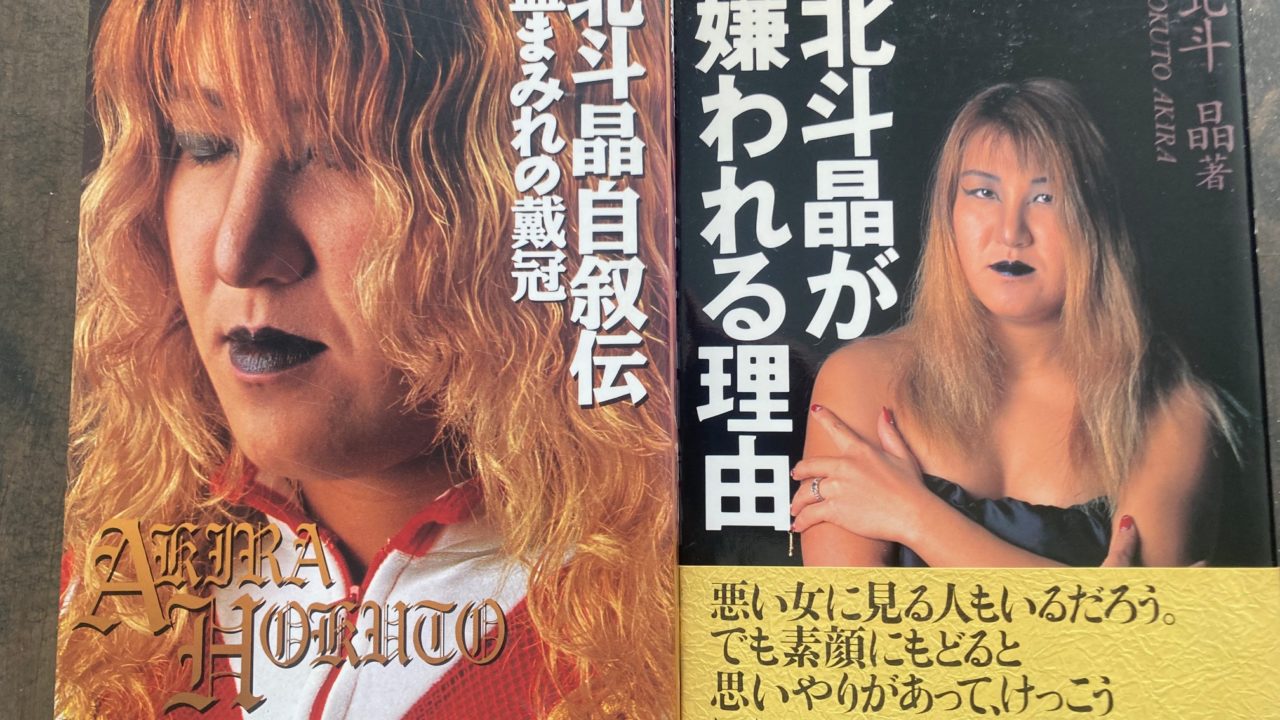
As Akira Hokuto/Hisako Uno slowly makes her way up the ranks she becomes more familiar with the secret truth of the world of joshi wrestling: it’s a cruel and unforgiving industry. In this section we’ll go over three key happenings that play a role in Hokuto’s growth as a person and as a wrestler. First, a sudden and unexpected loss shakes her belief in wrestling. Then things turn positive as she wins some awards/titles. Lastly, we’ll close with another negative as she describes the atmosphere around her darken. Through Hokuto’s words we’ll get a glimpse into just how rough life was for these young women as they fought and clawed over each chance at success.
You can read part 1 here and part 2 here.
Part 3: Training Camps, Title Belts, and Loathing
We begin with Hisako’s first training camp and her starting salary of ¥45,000 per month (around $450). Because it was so little and she had to spend most of it on food, Hisako asks her parents to lend her money for basic necessities and training clothes. She recalls that she was so tired so often that her and her peers’ cravings for sweets would lead them to pick up and eat leftover chocolate and cookie crumbs discarded by their seniors. Once she starts appearing in matches that salary increases to ¥70,000; not much but it’s something.
Rather than take time off, Hisako is invited to a second training camp taking place on Hachijo Island (an island some 230kms south of Tokyo) along with pretty much her entire rookie class and a few seniors. Upon arrival they’re divided into three Groups, A, B, and C, ranked based on professional quality. Hisako ends up in Group A to practice alongside her seniors and includes, among other things, a practice called “100 throws”. Each senior throws the rookie ten times in a row. The rookie must get up without rest until all 100 are complete. By comparison, most people start feeling sick or dizzy around twenty. Crying, stumbling or being out of breath mean nothing. Having already experienced this practice before the training camp, Hisako feels blood drain from her head the moment she hears it announced…and secretly hopes that another group might be forced to participate as well.
On the first day they’re up at 4am doing ukemi/breakfalls. This goes on for so long and is so intense that a 20-minute walk from the training area to the inn takes an hour to complete. The training leaves Hisako parched but she can’t drink any water until both her seniors have had their share and have allowed the juniors to drink. After a brief afternoon nap, training resumes with karate practice. Afterwards, two trainees from Group B join Hisako in Group A: Maki Sato and Fumie Kanzaki.
Sato is only fifteen, comes from a ballet and gymnastics background, and is timid yet mischievous. Both Hisako and Sato go through dropkick practice but at one point Sato tells Hisako her head is throbbing. This is dismissed by everyone, but later that night Sato is heard snoring very loudly, which concerns Hisako since she doesn’t want either of them to incur their seniors’ wrath. She shakes Sato awake but when Sato awakens her eyes are “bright red”. Sato brushes this off but the next day she leaves the practice. Later that day Hisako observes Sato jumping properly and then they move on to bodyslam training. But as they start someone observes Sato lying down, groaning. Then she begins rolling around clutching her head. Someone calls for an ambulance, and then her body goes limp. Soon afterwards the paramedics arrive but they see Sato’s pupils dilating.
The next day Hisako is brought to the village police department and she is basically interrogated by the police. She confirms nothing unreasonable had been asked of her or anyone else. The training camp is canceled midway through and everyone returns to Tokyo by boat. A few days later Hisako discovers her shoulder popped out of place so she can’t wrestle. One night she’s resting on the bus when she is informed that, unfortunately, her friend Maki Sato passed away at fifteen years old. (APOD: This is a terrible tragedy and a completely avoidable one. Aside from the obvious danger of having teenage girls take breakfalls on a hard wrestling ring, why would anyone take such vulnerable bodies to a tiny ass island without proper medical infrastructure? Couldn’t they do the training camp on the mainland, maybe somewhere near a major train line?) Everyone from AJW attends Sato’s funeral and puts on white chrysanthemum and Hisako gives the swimsuit Sato had planned for her debut back to Sato’s mother during the memorial service.
After that depressing turn, Hisako heads back to work and discusses her debut, which doesn’t follow standard procedure. At the time, the typical route for joshis went like this: pass the audition à pass pro test à five-minute exhibition match à repeat step three until you can properly perform à ten-minute one-fall pro debut match. Due to a management error, Hisako’s goes like this: pass the audition à several five-minute exhibition matches à twenty-minute one-fall match.
Rookies seeking to become full-fledged pros are given two opportunities in a given year. These are big tests with a steep pass/fail cliff: pass and you’re a pro; fail and you’re sent home because, in the eyes of management, you’re not suited to be a pro wrestler (APOD: I can’t help but wonder if these steep demands really were good for business; on one hand they gatekept and protected the quality of their stars; on the other hand once the candidate pools dried up could they really afford to be so selective?). In Hisako’s case that number was changed to three times per year due to the higher number of rookies. Come the end of 1985, three in her group had made their pro debuts, leaving the other twelve, including Hisako, placed in a tournament to determine something called the Rookie King Deciding Match. Hisako doesn’t get a lucky draw as she’s paired with Yumiko Hotta in the first round. Hotta, having failed the standard AJW entry test, made it in a different way thanks to recommendations from her karate instructor. But despite that background, and despite Hisako having lost 12kg of weight since her first day, Hisako wins. Next she does to a draw against Megumi Nakamae, which she’s okay with since she wrestles in front of her parents.
Hisako and Nakamae have a rematch which is taped at Ota Ward Gymnasium in Tokyo. By that point Nakamae has donned heel face paint while Hisako, despite being in a similar villainous stable, doesn’t wear any. This match goes to a 20-minute draw and a panel of judge’s award the win to Hisako. But before she can celebrate her next challenger, Sakamoto, makes her way down to the ring, all 100kgs of her. Hisako loses this match in short order but she gets another victory a few days later in the form of the Women’s Pro Wrestling Award for Rookie of the Year.
As 1986 begins she finds herself dealing with a new wrinkle in the form of the next crew of trainees. By moving up a wrung she can now assign tasks to others but on the flipside she is also expected to coach and teach, which bothers here since she sees herself only half capable of doing certain things. She also notes that, aside from the usual labor, she also had to deal with fans coming up. At the time the Crush Gals were explosively popular and, by association, even the odd rookie got a fan or two, drawn to the women’s sweat and earnestness. However, AJW had a strict rule that rookies couldn’t sign autographs, shake hands with fans, or accept letters or presents for the first year. This is to prevent rookies from getting big heads. Still, Hisako is happy and excited that someone new is coming to the dojo…and seems to form an early friendship with the girl who would soon become known as Aja Kong.
Akira Hokuto speaks from the present for a moment to discuss title belts. At the time she only recalls having won three: the AJW Junior Championship (a rookie’s belt), the WWWA World Tag Team Championship, and the All Pacific Championship (a secondary belt). The years after she turned pro AJW would add more belts in response to the growing roster. However, many of these she describes as “worthless”. To her the value of a belt depends on who holds it and having so many lessens her desire to wear any of them.
“There are a lot of belts. Compared to that, there are few active wrestlers. Right now, in All Japan Women’s, there are too many belts that anyone can wear. It feels strange if you can’t wear one. Even the number of competitors within All Japan Women’s is small. Even the Junior Champion belt, which has a long history, is currently being contested by only three people, and even such a prestigious belt is losing its value. This is really sad for me. Because, out of all the belts I’ve held, the one I was happiest to have was this Junior Champion belt.” – Akira Hokuto in 1994!
(APOD: Someone send this to Triple H & Tony Khan!)
Going back to 1986 while staying on topic, Hisako recalls challenging for the AJW Junior Championship against Condor Saito. Despite being a member of Dump Matsumoto’s Atrocious Alliance, Saito was caring towards her juniors. She learns of her challenge a month beforehand, and is thrilled because she’s the first in her group to get a title shot. On some night she was so excited she couldn’t sleep and thus ran through the streets of Meguro. Then on March 20th, Hisako Uno beats Saito to win her first wrestling championship, which she considers her most cherished memory.
Over time Hisako comes to understand her seniors more and learns that the scariest when angry is Yukari Omori who rarely got angry in the first place but when she did she was terrifying. She was even scarier than Devil Masami, yet Hisako admired her more than anyone else, even the Crush Gals.
Hisako skips ahead to early 1987 with her and Yumiko Hotta now teaming together. They were being hyped as the second Crush Gals and parlay that popularity into a challenge for the WWWA World Tag Team Titles. Six teams are put together in a tournament to crown #1 contenders. There is a bit of an inconsistency here as some sources state the duo of Leilani Kai & Judy Martin as defending champions while others put them as teams participating in this tournament. Either way, Uno & Hotta beat them to win the titles. Despite their shared joy at their victory, Hisako notices several seniors looking at her & Hotta frighteningly coldly, which Hisako attributes to outright jealousy over two “rookies” winning the belts. However, Hisako doesn’t say anything aloud, not even to her partner, out of fear that it might get back to those seniors. She doesn’t imply that Hotta would rat her out; rather, it’s a sense that “the walls have ears”.
Hisako confirms the infamous Three No’s of zenjo: no alcohol, no cigarettes, and no men, and recalls hearing someone spreading rumors about her that she was smoking despite this ban. Her problems are exacerbated by increasingly hostile cliques: most of the roster was split between Devil Masami’s faction and Dump Matsumoto’s, while rookies like Hisako didn’t belong to either. In a replication of high school, Hisako finds herself singled out by seniors who make each and every decision of hers complicated. They’d get stiffer with her, kicking her and bloodying her nose when she was down during the “100 Throws” training. She recalls crying and calling her parents she wanted to quit. And yet she kept them in the dark about the harsh truth of her life: they were convinced she lived a glamorous life in a wonderful world. Wanting them to be proud, she omitted the truth when speaking of them. In one case, while staying at a countryside inn for a local show, the innkeeper’s wife encourages her and told her to picture herself beating those who are bullying her now. After she leaves an unnamed senior tells her “if you’re going to quit, quit quickly!” Feeling reckless, Hisako decides to run away.
Despite her love of pro wrestling, Hisako can’t continue with this locker room. It turns out that there’s one particular senior is causing all of this bullying and the practice of daily 100 Throws is her doing. As it turns out, though, Hisako isn’t the only one contemplating leaving: three wrestlers Hisako’s senior also decide to leave: Condor Saito, Mika Komatsu, and Bull Nakano. Hisako departs by herself, however, and as the show is starting in Aomori (on the northern end of Honshu), she’s already in Tokyo and filled with regret over having lost to that senior’s bullying. She doesn’t know how much time goes by but eventually the office calls her and the other three women who did end up leaving as well, inviting them back. It turns out their absence had a profound impact on the event which gives Hisako a renewed sense of self-worth.
Ultimately Hisako returns, apologetic. For her transgressions she is now at the bottom rung. Still, she tries to be optimistic; however a completely different set of challenges awaits her in the months ahead.
APOD: That infamous documentary “GAEA Girls” that showcased the brutality of joshi training only scratched the surface. Hokuto’s firsthand accounts of what she saw here are gutwrenching, especially considering she was still so young. A friend of hers DIED in training; how AJW wasn’t bankrupted from lawsuits or from any subsequent bad press is a mystery. My guess it has something to do with cultural differences around “dying on the job” and an overall different attitude towards death compared to us Westerners. Aside from that, Hokuto paints a sobering image of the zenjo locker room and shatters preconceptions that it was more collective and unity-focused by virtue of it being in a country that puts individualism behind group success. According to Hokuto, AJW’s locker room was no less catty, political, and byzantine than American promotions. Hokuto’s unnamed seniors bullied her out of jealousy of her success and fear of their spots. So much for the unified front. And unfortunately, things will get MUCH more difficult for Hisako Uno, both as a person and as a blossoming wrestling star.
As always, thanks for reading.