

5-Star BOOK Reviews: Akira Hokuto’s Books, Part VIII
By Alex Podgorski on 17 April 2026
Welcome back to my coverage of Akira Hokuto’s books. This time around we’re looking at the fallout from AJW Dream Slam I and Hokuto’s legendary match with judoka Shinobu Kandori. As mentioned last time, that match was the most famous part of her career, but it came at a serious cost to the woman herself. Yet despite her initial reactions to her post-match pain and injuries, Hokuto’s star power increases from there. That’s what we’ll look at here: the rest of Hokuto’s 1993. We’ll look at the other big matches she competes in, her next round of injuries and surgeries, and how she deals with (what is presumed at the time to be) her actual retirement in December.
You can read part 1 here, part 2 here, part 3 here, part 4 here, part 5 here, part 6 here, and part 7 here.
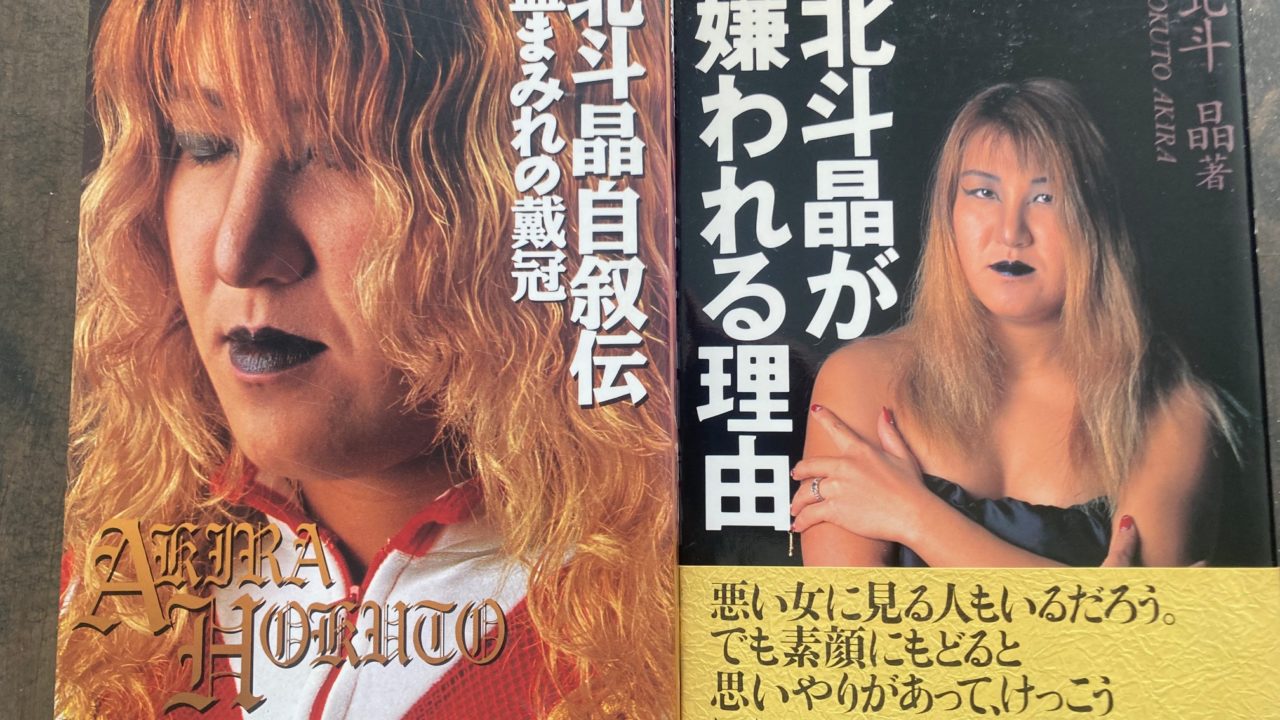
Part 8: Akira Hokuto becomes a superstar
In the wake of Hokuto’s titanic clash with Shinobu Kandori at Dream Slam I, LLPW tries to capitalize on the buzz with some matches meant to continue the feud and expand on the interpromotional dynamic. Sometime in June a wrestling reporter asks Hokuto about her appearance for an LLPW show, at which point she learns that a six-woman tag match featuring them both was decided without her involvement. Feeling insulted that decisions were made without consulting her – and knowing how big of a draw she had become following the larger-than-expected media coverage of the Dream Slam encounter – Hokuto refuses to participate so Suzuka Minami wrestles in her place.
Hokuto’s refusal angers LLPW president Rumi Kazama, herself a former boxer and kickboxer. Hokuto doesn’t like Kazama for a bunch of reasons, the main ones being that they share similar personality traits and Kazama seems to throw her weight around with her title and position. At some point Kazama manages to goad Hokuto into wrestling on an LLPW show later on and Hokuto feels dumb for falling into such a trap.
Continuing the interpromotional aspect of the time, the 1993 Japan Grand Prix (AJW’s version of the G1) includes wrestlers from other companies. LLPW provides Harley Saito and JWP provides Hikari Fukuoka. Hokuto’s first tournament match has her booked against Saito, but before she can get there she encounters a problem with her left knee. During a previous tour of Hokkaido, Hokuto landed awkwardly during an outside plancha and dislocated her left knee, the one that had never given her problems before. Touching her knee sent pain shooting from her body. Standing up would cause it to slip or dislocate. Going up stairs was fine but going down made her knee bones wobble and shift out of place (APOD: having traversed both urban and rural Japan, I can tell you this this would be a major problem given the ludicrous amount of stairs all over the country). On many occasions Hokuto would sit on stairs for almost an hour. Her response for matches would to tape her knee so tightly her bones wouldn’t shift. But this proves to be a literal Band-Aid solution; she knows surgery is imminent but, like every single other wrestler to ever lace up a pair of boots, she’s afraid of taking time off when her popularity it at its highest. And since there was a rematch with Kandori looming, Hokuto continues wrestling every match she can. However, on the day she’s scheduled to face Saito the LLPW wrestler isn’t there due to a rib injury so instead Hokuto faces a surprise wrestler announced that night. She expects Kazama but instead it’s someone named Beniyasha (a.k.a. Yasha Kurenai) who was doing a delinquent gimmick at the time. Anyway, Hokuto squashes her in just over two minutes with a Northern Lights Bomb. Hokuto doesn’t have anything against Kurenai but suspects that this poor rookie was thrown to the wolves at Kazama’s behest so Hokuto taunts Kazama in a post-match promo.
The match with Saito does indeed take place…about two months later (APOD: It’s a long tournament stretched over three-and-a-half months with smaller spot shows mixed between bigger ones) in which Hokuto’s bad left knee does indeed give out but she toughs it out, because of course she does. In a fitting turn of events, Hokuto reaches the finals of the tournament and faces Yumiko Hotta, who was her peer from the same 1985 graduating class. And even though she wins the JGP for the first time, Hokuto doesn’t relish in her moment as much as she thought she would because her mind is still fixated on Kandori. It also doesn’t help that her moment of glory is overshadowed by a sudden spine injury on top of her bad knee.
Four nights later at AJW Legacy of Queens in Nippon Budokan, Hokuto faces Kazama while doing everything in her power to conceal her spinal injury. Though some of her peers reassure her that kickboxer Kazama’s kicks aren’t that painful, Hokuto can’t take any chances. Right before her match she takes multiple injections which leads to quite a bit of blood coming out. She contemplates wrapping her knee up but can’t risk that being exposed because if Kazama (and the fans) see that obvious bandage job they’ll expect it to be attacked. When the time comes for them to wrestle Hokuto’s initially unintimidated at the “little squirt” in front of her (Kazama stood five feet tall and barely weighed 125 pounds). But then the bell rings and Kazama boots Hokuto square in the eye. Hokuto fights back from there and spends more time fighting against time and her pain meds wearing off. She eventually wins, grabs the mic, tells Kazama to let her finish her business with Kandori and then calls Kandori out. Sure enough, Kandori had been watching from the shadows and answered the call. Hokuto lays down the challenge but, in similar fashion to Undertaker/Shawn Michaels in 2010, Kandori demands Hokuto put her career on the line.
This is where things get tricky because, once again, Japanese is an indirect, ambiguous, and interpretative language. After Kandori accepts Hokuto’s choice of time and place – December at Ryogoku Kokugikan, an event called “St. Battle Final” – Hokuto states, “I will fight, staking the career of Akira Hokuto.” Later during an interview with the press, she’s asked many times if this means she’s retiring. Things get lost in translation – or in this case, lost in interpretation. What Hokuto meant with these words was “I’ll put everything from my nine years in pro-wrestling into this match with Kandori.” However, everyone outside Hokuto’s head who heard these words interpret them as “I’m putting my career on the line”. But since she can’t go back on her words, Hokuto goes ahead with this wager.
As expected, Hokuto is summoned to the managers’ office the next day. This is a common place for her: over the course of her career she’d been scolded many times, usually for her post-match mic appeals. She paints this relationship as her being a problem child facing down a disappointed parents and notes how the chairman wouldn’t ever yell at her but would shake his head at her words. “Once you spit your saliva, you can’t swallow it back”, she summarizes. She confirms with him she’ll retire if she loses and to prove she means it she offers to return her AJW All Pacific Title belt to him. However, he doesn’t accept this so later that day she meets with Kunimatsu Matsunaga, said to be the boss closest to the wrestlers. Surprisingly he tells her to live her life as she wishes, which gives her a renewed feeling of freedom, both as a wrestler and a person.
With this in mind, Hokuto plans on having surgery ahead of her match with Kandori. But as preparations are made she has another tour without breaks. Hokuto gets a brief moment of happiness as she has a joke match with Numacchi that ends in seven seconds. That joy disappears moments later when Rumi Kazama reappears and this time she has her own set of demands: a hair match against Hokuto. However, Hokuto refuses, not wanting to be goaded into another trap with her mind still set on Kandori.
September comes to an end and Hokuto prepares for surgery. But the day before she goes under the knife Kazama appears in her private hospital room demanding an answer. Hokuto tells her to get signatures from all the women in LLPW and then she’ll consider it. The surgery goes through and she reveals the exact cause of her pain: a combination of stretched ligaments and her left meniscus being cracked and protruded, touching a nerve. After only four days, Hokuto is discharged and goes to Nagoya on crutches to hell Kazama “NO” in person. Along with her aforementioned focus on Kandori, Hokuto doesn’t want Kazama to lose three important things: her hair, her reputation as LLPW’s president, and her pride as a pro wrestler. Hokuto arrives to the arena in Nagoya and witnesses Kazama, true to her word, present a signed sheet with all of LLPW’s wrestlers signatures on it. In response, Hokuto takes the agreement, rips it up, and says, “This is what’s going to happen to your hair.”
But before she can get there, Hokuto has another big challenge to deal with: as JGP winner she earns the right to face the WWWA Champion, Aja Kong. Hokuto puts Kong over big time, noting how well she moves despite her size. She also emphasizes Kong’s sharp-mindedness and how it’s nearly impossible to outwit her. And when people tries to outwit her she thinks even farther ahead which makes her one of the most confident wrestlers around. At the same time, Hokuto thinks that Kong’s reputation has led to fame and that fame has distorted her public image. Rather than be seen as a strong wrestler, Hokuto believes Kong is perceived as a funny entertainer by the masses. Yet those who know her would see Kong as the second coming of Dump Matsumoto. Though she’s an opponent in this case, Hokuto encourages people to watch Aja Kong more because she has seen some of the things Kong has endured. She doesn’t want to write about specifics without Kong’s permission but she recalls witnessing Kong crying in secret, how she knows “the true terror of loneliness in life”, and has been through more hardship than anyone else she can think of. (APOD: For those that don’t know, Erika “Aja Kong” Shishido had an extremely rough childhood. As if being biracial wasn’t bad enough in an ethnically homogeneous Japan that prioritizes conformity above all, but she also came from a broken household as her father, a soldier in the US Army, had to divorce his wife when he was repatriated. As we’ve seen with Toshiaki Kawada, Kenta Kobashi, and Mitsuharu Misawa, a single-parent household, particularly a single-mother household, was often a source of adversity. But Kong’s circumstances were significantly worse. She was bullied relentlessly at school and her mother’s family ostracized her mother for her relationship with the girl’s father. Shishido found solace in wrestling but when she was signed she was booked to be a villain because she was perceived to be monstrous and much easier to boo than cheer. This is why I tried so hard to find an extant copy of Kong’s book when I was in Japan back in November: her own accounts of her life and how she achieved so much despite so many challenges set in front of her from an early age would’ve been a treasure trove and a delight to share with you all).
Anyways, Hokuto initially considers withdrawing from the WWWA title match because she doesn’t want to disrespect Kong or the title by wrestling in her current state. However, when JWP approaches her for a match with Mayumi Ozaki under the premise of “this may be your last chance’, Hokuto realizes she might be in several “last time” situations and goes through with both. Every situation is framed as a half-shoot with her approaching her Kandori retirement as having a 50-50 outcome. Going back to the bout with Aja, Hokuto cuts a sudden promo right before the bout asking Kong to withdraw the defense portion and make the bout a straight singles match. Kong agrees and the match turns into an exhibition of what being an AJW wrestler is all about and a showcase of the lives they’ve lived in AJW. (APOD: You can watch the match here. Meltzer apparently gave it **1/2 but it was nowhere near as bad as that).
In the following weeks Hokuto puts more effort into taking care of her body. She changes her diet and wrestles more cautiously on the provincial tours so that she can have her next three important matches. Despite having to treat her own body like fragile glasswork, Hokuto makes it to the LLPW event to face Rumi Kazama. That day comes and there’s tension backstage with the AJW women visibly upset with their card placements (APOD: at least it’s an easy night for all of them: Aja Kong, Toshiyo Yamada, Manami Toyota, and Kyoko Inoue all win their respective matches against LLPW wrestlers in between one and seven minutes). Then comes the main event of Hokuto vs. Kazama. Hokuto learns Kazama has a bad back she, out of spite, opens with a backbreaker. That spite bites her in the ass as she drops the heavier-than-she looks Kazama on her recently operated on left knee. Still, Kazama takes the brunt of the damage and Hokuto adds insult to injury by trying to win the match with a joint lock. She picks a sleeper hold and submits Kazama as Kandori looks on from ringside.
Kazama starts cutting her own hair but Hokuto stops her. Apparently Hokuto disagrees with the notion of a woman cutting her hair for wrestling’s sake, thinking it exists “outside of pro wrestling” (APOD: This comment ignores just how big hair matches were and still are. Not only did Hokuto spent quite a bit of time in Mexico where apuesta/wager matches have been big money draws for decades, but women’s hair matches are a big part of joshi history as well. The hair match between Chigusa Nagayo and Dump Matsumoto in August 1985 is one of the biggest women’s wrestling matches ever and Toyota vs. Yamada from August 1992 was fought under “Hokuto’s AJW” and was added to many Japanese tapes to make it to North America). Kandori gets involved and suggests Hokuto withdraw the retirement stipulation as well if she can’t accept the emotions of hair being cut. Hokuto sees this as a bluff and doesn’t sell it.
Next Hokuto pivots to JWP and her match with Mayumi Ozaki. Hokuto feels ambivalence towards JWP but buries their roster in secondhand fashion by saying the only person she wants to fight is representative Yamamoto, who is a man. Hokuto dismisses Ozaki as a kid with a long face and a small body, and this is coming from a woman who considers herself small (APOD: around this time Hokuto was around 60kgs/133 pounds). However, Hokuto praises Ozaki’s tenacity and this turns into a comparison of JWP and LLPW. Hokuto concludes that JWP has skilled wrestlers up and down while LLPW has unskilled wrestlers, especially in terms of showmanship. And yet, Hokuto thinks that there’s such a thing as being too skilled and compares this to food, as most wrestling critics tend to:
“From my perspective as Akira Hokuto, being too skilled makes things boring in a fight. JWP is like Chinese food that fills you up just by looking at it—your eyes are satisfied. LLPW is like bizarre food that makes you wonder what it tastes like, and you want to try a little bit. That’s how it feels. For Akira Hokuto, the bizarre food is more interesting.
But, more than the Chinese food that fills you up just by looking, or the bizarre food that piques your interest, All Japan Women’s Pro Wrestling, which is like French cuisine where various dishes keep coming out and each one is satisfying, is still the best!” – Akira Hokuto
November 1993 goes by and Hokuto sees interest in the interpromotional war fading. Staying in line with this food theme, Hokuto compares this waning interest as eating the same thing every day and, no matter how much you like it, you start wanting something different. To keep herself going, Hokuto keeps thinking of her match with Kandori as something outside this interpromotional framework. But before that she has an eight-woman survival/captain’s fall tag match against four JWP women. Hokuto doesn’t appreciate the complicated rules so she doesn’t put that much enthusiasm into it. She also sidetracks to a short discussion about Dynamite Kansai and says both of them are narcissistic. Still, Hokuto puts Kansai over as a big star in JWP and says she’s on par with Aja Kong in some ways. Team JWP win but on her way back to the locker room Kansai challenges Hokuto to a singles match. Unfortunately, this match doesn’t take place.
December 6th. St. Battle Final. Hokuto wakes up with a fractured chest bone and three broken front teeth courtesy of Dynamite Kansai. The gloomy weather matches her mood. Though she tries to act cheerful and jokes with her peers playfully, as she approaches what is presumed to be her retirement match she starts getting nervous. She enters the ring and tries to read Kandori’s face. Hokuto thinks that Kandori’s underestimating her since she doesn’t sense the same killer aura she had at Dream Slam. This time around there’s a reversal with Kandori scoring the first blow with a punch to the mouth that darkens Hokuto’s vision. Hokuto takes a moment to recognize some criticism that her matches with Kandori are closer to fights than matches yet she justifies this by saying that wrestling has many kinds of battles. Her specific choice of wrestling is one that can make the audience feel the pain (APOD: This is very similar to Toshiaki Kawada’s way of wrestling which was one that pursued invisible pain that the audience could better understand). She also summons her lessons from Mexico and emphasizes that wrestling is a free fight and no one can deny the kind of wrestling you choose (APOD: If that were so then there wouldn’t be an entire ecosystem built on criticizing this wrestler and that wrestler). Once again, Hokuto doesn’t remember much from the match itself, only the final moments. Pain like her jaw was shattering. Her legs unsteady. Some sort of Tiger Driver-like move that she had to avoid. And then she finds herself staring at the ceiling lights. Kandori had won.
She hears crying from ringside: Mima Shimoda, Etsuko Mita, and Aja Kong are all crying for her. She walks to the back and demands that the reporters focus on the winner, Kandori. Then Rossy tells her she has to do a press conference. Though she says her feelings remain unchanged, Commissioner Ueda refuses her retirement and demands she open her ears. Even twenty minutes after the match ends fans are still chanting Hokuto’s name. In the dressing room LCO cling to her constantly, sobbing. As she gets driven home some fans follow her in their own car and keep screaming “don’t quit!”
Hokuto shuts the door and stays in her apartment for three days straight. She finds over 100 messages on her answering machine but doesn’t respond to any as she continuously ponders her future. For someone who only knows pro wrestling, is there even a life after or outside of it? To clear her mind her first action is to clean her apartment. Sifting through all the random stuff strewn about Hokuto finds a copy of Weekly Pro Wrestling in which there’s an article about her and Manami Toyota teaming together in the annual tag tournament. This makes her wonder “what’ll happen to Toyota if I leave?” and makes her forget her selfish ways for a moment. If she doesn’t appear for the tag tournament final, what would that say for her efforts and, more importantly, Toyota’s? After a few more instances of doubt, Hokuto vows to attend the show so that her selfishness doesn’t ruin things for Toyota.
The Tag League final takes place on December 10th and sees Hokuto & Toyota take on Toshiyo Yamada & Kyoko Inoue. This ends up being a double-feature because Yamada & Inoue win the first match which leads both teams tied for points and thus needing a sudden finals decider. Once again, Hokuto and the other combatants were so exhausted that none of them can remember specific details of the match. Still she takes a moment to thank Toyota for fighting alongside her. A few days later there’s an awards ceremony for women’s pro wrestling and starting in 1993 other promotions are welcomed. Hokuto reluctantly agrees to let her parents attend but warns her mother not to attack Kandori for what she did to her daughter. As Hokuto navigates this shindig and rubs shoulders with industry veterans she hears lots of comments about her retirement and people telling her she can still go. The night goes on without much surprise when suddenly Hokuto hears her voice called for the MVP awards (i.e. the top award). She thought that MAYBE she’d be considered for the Merit/Effort Award but no, she’s voted best #1 women’s wrestler and takes her spot on the dais. Though she shows strength and accepts her award without emotions, the moment she’s out of the spotlight tears flow down her face. (APOD: I believe she’s referring to AJW’s internal awards since she won the Rookie Award years earlier. In essence these are closer to WWE’s Slammys: internal recognitions that may or may not be kayfabed. I don’t think these are the Tokyo Sports Awards which are voted on by what amounts to a governing body with much more legitimacy than bosses handing out end-of-year gifts to their biggest draws to drum up more interest; however Hokuto sells this like it’s a very big deal so maybe it is.)
APOD: There was a lot to get through here as Hokuto wrote this section under the assumption that she was indeed going to retire by year’s end. Ignoring her misspoken words in that promo with Kandori, Hokuto spent most of 1993 in excruciating pain. Her knee and spine were messed up, she constantly took full-contact punches to the face, and her mobility was limited so severely she couldn’t even go down stairs without extreme effort – and she wasn’t even 30 years old. This section really highlighted the physical struggle wrestlers put themselves through. Additionally, Hokuto’s constant self-doubts and those invasive thoughts of retirement and questioning of her choices keep this book grounded in believability: no wrestler is well and truly dedicated to wrestling to the point of never questioning themselves (except maybe Kenta Kobashi on an off day). Hokuto’s constant struggles with her own inner thoughts helps paint this story in more human colors: in the end she’s a real person with flaws and doubts and she’s conscious enough of them to include them whenever conflict emerges. She knows she’s selfish, stubborn, and a tad immature, and she doesn’t try to use these qualities to make herself endearing to the reader. She’s not a cookie-cutter Disney princess but something perhaps closer to a tragic heroine and that makes her much more compelling to watch than a live-action cartoon character.
As always, thanks for reading.