

5-Star BOOK Reviews: Akira Hokuto’s Books, Part X
By Alex Podgorski on 8 May 2026
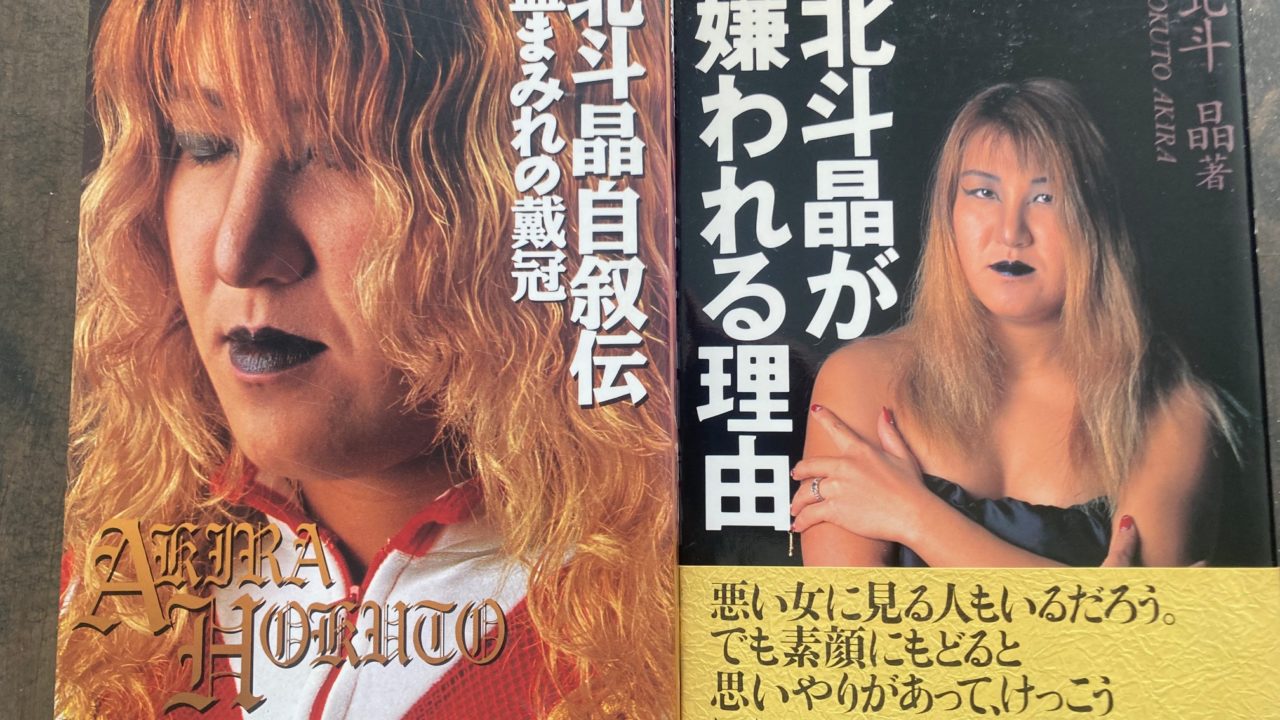
Welcome back to my coverage of Akira Hokuto’s books. In this one we’ll go over the first part of Hokuto’s second book WHY AKIRA HOKUTO IS HATED. This book starts off where her autobiography BLOOD SOAKED CORONATION ended and goes until the end of 1995. This is a busy period for Hokuto as it includes several big events in her life: the AJW Tokyo Dome event Big Egg Wrestling Universe, the Collision in Korea event, her meeting future husband Kensuke Sasaki, and much more. It also includes testimonials from many people including her AJW peers, wrestling journalists, her mom, and Antonio Inoki for some reason. Needless to say, this, too, should make for an interesting journey.
You can read part 1 here, part 2 here, part 3 here, part 4 here, and part 5 here, part 6 here, part 7 here, part 8 here, and part 9 here.
Part 10: Akira Hokuto’s Internal Despair
HATED opens with Hokuto feeling in a daze after the Tokyo Dome event. She describes herself as a marionette with its strings cut, unable to move forward or backward, or in any direction. There was a growing sense of her being free to do whatever she wanted, but at the same time this lack of direction made her feel like no one was paying attention to her (APOD: which must be rough for someone who openly acknowledges her own selfishness). With even one string cut the marionette collapses which Hokuto uses to describe her state of body and mind. After this she moves back to her family home, having lived in Meguro for ten years. In a hilariously ironic twist, she states the following: “Ours was a family always full of laughter, and I was happier than anything to be able to live with them again.” (APOD: this appears to be a blatant retcon of how she described in BLOOD SOAKED, where she was lonely, teased her sister, and suffered emotionally over the revelation that she wasn’t wanted when she was born). She describes feeling a satisfying peace while at home and suggests that a wrestler’s fierceness and aggression might come from a place of sadness (APOD: She has a point: there seems to be a connection, albeit anecdotal, between kids having difficult childhoods and them seeking validation from crowds). But this peace doesn’t last as she must prepare for a trip to (South) Korea.
That Korea trip ends up largely forgetful with Hokuto lacking in passion no matter how much Rossy Ogawa tried to rekindle it with new match-ups. Shortly afterwards her grandmother passes away, with her last words to Hokuto being “take care” on the eve of Big Egg Wrestling Universe. During the funeral ceremony Hokuto observes her grandmother’s left eye keeps opening and compares it to her already having weakening vision in her own left eye. She takes this as some sort of sign. She returns to Mexico as soon as she can, both to get away from the emotions of her grandmother’s death and to re-embrace the greater freedom she finds abroad (APOD: these statements show just how contradictory and all over the place things seem in Hokuto’s mind. First, she complains that AJW giving her freedom is akin to a marionette having its strings cut, then she complains that in Japan wrestling under such direction leaves her feeling suffocated. She really can’t make up her mind, can she?)
1995 begins and Hokuto receives a surprise offer to do commentary for Antonio Inoki’s match on NJPW’s January 4 Tokyo Dome show. She doesn’t really know why people call her the “female Inoki” since she knows her chin isn’t as long as his. She uses this as an opportunity to recall her appearance in the ring for the AJW Dome Show and she doesn’t seem to have many fond memories of it. She describes that show as a “wall”, one with immense negative connections, and tries her hardest to forget that show as much as possible. Upon arrival at the Dome for NJPW Battle 7 as it’s called that year, TV Asahi tells her she can way whatever she wants about Inoki. She’s also told she can do whatever until Inoki’s match starts so she ends up watching a few other matches alongside Rossy Ogawa. It’s here she points out that while she loves pro wrestling she hates watching it and so she gets bored quickly watching the event unfold. At that point the venues atmosphere, and Hokuto’s perception, change. The audience goes wild just for the opportunity to hear Inoki’s theme song and she recalls them roaring with excitement when Inoki beats Gerard Gordeau with a sleeper hold. Then she watches Sting beat a boxer so fake she couldn’t remember his name, and then sticks around to watch Inoki versus Sting. This convinces her to overcome the clouds in her mind, leading to this statement:
“No matter how much it hurts, as long as the crowd calls your name, as long as there’s a ring in front of us, we pro wrestlers must walk toward the ring. That is the fate of those chosen as pro wrestlers.” – Akira Hokuto
Hokuto returns to Mexico and experiences the peso crisis in real time. Further complicating the wrestling scene is the CMLL/AAA schism that she hadn’t touched on before. Although AAA opened in 1992 and existed the entire time Hokuto was touring Mexico, this marks the first time she sees the drop in CMLL’s attendance when wrestling them and considers AAA’s existence as an equally important factor as the country’s economic situation. She describes the low pay in detail: wrestler pay was a percentage of the gate and allocated based on card placement. As a woman, she was limited to either first or second match, never higher, even on a three-match card. Furthermore, all wrestlers had to pay for their own travel/taxi fare to and from the arena, and singles matches were rare. So, for a taxing six-woman match that would leave her sweating buckets, Hokuto would earn around ¥300, but would then have to deduct ¥250 for her taxi fare to and from the arena. In other words, there were times she made the equivalent of two or three dollars and others where she’s work at a loss. (APOD: Another monkey’s paw moment: Hokuto begged for freedom and found it in Mexico, but at the cost of not being able to make enough money to eat. Suddenly Japan doesn’t sound so bad). Then her emotional state worsens when her peer Suzuka Minami calls her to announce her retirement for health reasons.
In early March Hokuto receives a call from Rossy to do commentary for AJW’s Yokohama show later that month. Around the same time Inoki announces his intentions to hold a show in North Korea so she reaches out to him to join and he agrees. She also pivots to talking about Bull Nakano, whom she considers more of a sister at this point than a peer or a mentor. At one point they roomed together to save on rent, and Hokuto jokes that Nakano would do anything for her akin to a servant to a queen. It’s here that Hokuto lays bare her deeply-rooted selfishness and acknowledges how hard it must be for those around her to deal with her:
“I know it myself, but my selfishness and self-centeredness are no joke, and keeping up with me is tough. Anyone half-hearted would get fed up. That’s probably why people dislike me, but Bull was the only one who never got tired of me and stayed by my side like a sister for ten years. Whenever something bothered me or I didn’t like something, I would cry and scream until things went my way. No matter what, Bull would say, “Uno-chan, you’re amazing, you’re different from everyone else, so it’s okay, hang in there!” They were just words of praise, but they always lifted my spirits, motivated me, and took away my anxieties.” – Akira Hokuto
Around the same time Nakano calls Hokuto out to address the latest round of rumors surrounding her imminent retirement. Nakano recalls her own statements that she’d retire when she lost the WWWA Championship but couldn’t stay away because she loved wrestling too much and vowed to keep going until she couldn’t go any longer. (APOD: Nakano and other women walking back their retirements seems like less of a big deal than men, likely because women’s wrestling wasn’t taken as seriously as men’s for a long time. When Atsushi Onita followed the Terry Funk principle and came back after retirement it sullied his reputation and let to lots of negative public comments from other wrestlers, with Kawada once calling him “Mr. Tell-A-Lie” in a magazine). Nakano’s comments seem to add more to Hokuto’s growing desire to keep wrestling. A few days later Hokuto gets a phone call from an unnamed person telling her that Tarzan Yamamoto wants her to come to the Tokyo Dome for the 13-promotion Bridge of Dreams show (APOD: Maffew brought several of us Blog writers together to cover this mammoth event, which you can read here). Recalling her statement after the Big Egg show in which she’d come back at another Tokyo Dome event, Hokuto ultimately makes the decision to withdraw her retirement following the Bridge of Dreams show.
However, within a few weeks Hokuto is already rethinking that decision, this time owing to her physical condition and not her will to continue. She had a bad back that made standing painful, legs that often went numb which made walking difficult, and whenever she sat in a chair she couldn’t get up. A subsequent visit to a hospital reveals more details about her body: her pelvis is so misaligned that she shouldn’t wrestle at all anymore. By this point she can’t even walk anymore and her physical state has a strong likelihood of rendering her incapable of having children. Faced with the stark reality of her body breaking down, Hokuto ponders where her career will go from here, especially with one of the most infamous wrestling shows in history on the horizon.
APOD: Once again, we got to see more of the wild conflict taking place inside Akira Hokuto’s head. She showed more indecision throughout this section as she couldn’t really tell what she wanted and even when she did it was bittersweet. Several major decisions she made seemed to be presented as Monkey’s Paw moments, the most notable being her trip to Mexico in 1994/5 which got her the freedom she so desired at the cost of being able to make a decent living. It’s also clear from her tone, word choice, and constant self-reflections that she’s in a conflicted state, unable to decide between pursuing her passion and acknowledging her deteriorating physical state. There are also some subtle hints planted throughout as she talks of “being with someone” and having children, though those only seem like pipe dreams for the moment. But as we’ll see in the next session, fate clearly has other plans for her and she ends up finding her soulmate very unexpectedly.
As always, thanks for reading. Next time: Akira Hokuto goes to North Korea.