

5-Star BOOK Reviews: Jun Akiyama’s Books, Part IV
By Alex Podgorski on 14 September 2026
Welcome back to my 5-Star Book Reviews series covering Jun Akiyama. For this next section we’re going to move away from historical happenings and towards more conceptual topics. Akiyama chooses not to talk about his in-ring exploits; instead he focuses on his observations and reflections on events that affected him internally and externally. Most importantly, though, in this section Akiyama will give more detail on the mental roadblocks that manifested in physical limitations that made both wrestling and daily life much harder for him. While physical toughness has been discussed to death in a pro wrestling context, here we’ll get one of the best examples of mental toughness that often goes overlooked.
You can read part one here, part two here, and part three here.
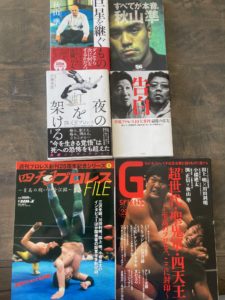
Following Akiyama’s ordeal with Kawada, Kobashi, and the press his career plateaus for quite some time. Unfortunately none of the books and magazines I’m referencing contain specific details for the next stretch so I’m filling it with my own research. The summer of 1993 sees Akiyama experience another boost to his career in the form of a six-man tag match that Dave Meltzer rates 5-Stars. The key thing to note is that Akiyama is only nine months into his career and Meltzer is reportedly hearing whispers among Japanese journalists that Akiyama is already being treated like a multi-year veteran. However, Akiyama fades into the background over the next little while as the period from May 21, 1993 to December 9, 1995 is, unquestionably, the era of the Four Heavenly Kings. Although Akiyama teams with Misawa & Kobashi a lot during this time he isn’t given as much attention. Akiyama’s achievements during this period are somewhat middling. In 1994 he wins the Asunaro Cup, a rookie’s tournament, and participates in his first Champion Carnival. Although he finishes in the middle of the pack with only nine points, he has strong performances opposite Kobashi and Dr. Death during this tournament. He and Omori team up in the year-end Real World Tag League where they finish in the middle, winning over lower-card teams. Little else of note happens to him but on a nightly basis Akiyama finds himself either teaming with or facing his three most important stylistic benefactors: Kawada, Taue, and Fuchi. He confirms this in SPIRITS, describing them as more important to his in-ring developments than Misawa or Kobashi, despite the latter still training with him during off-seasons and in the dojo.
The shallowness of AJPW’s roster leads to strange pairings throughout January 1995: although Akiyama is a member of Super Generation Army there are nights on which he teams with Tamon Honda who is aligned with Kawada & Taue. In matches featuring Giant Baba the teams are further realigned leaving Akiyama as both Baba’s partner and opponent. Later that month AJPW books a tournament to crown new All Asia Champions after the previous champions, Furnas and Kroffat, vacated them ahead of the ’94 Tag League. On January 29, 1995, Akiyama and Omori defeat the Fantastics duo of Bobby Fulton and Tommy Rogers to win the vacant titles, which they’d go on to hold for almost three full years.
In SINCERE Akiyama claims his slump ends when he and Omori wrestle Satoru Asako and Tsuyoshi Kikuchi. Despite losing, in that match Akiyama feels in control for the first time and thus leads the match as he sees fit. This serves as the underpinning of his slump: being unable to have the match go as you want and being unable to forcibly switch the flow to your own are frustrating experiences in wrestling.
Despite leaving his slump, however, Akiyama makes it crystal clear that he isn’t a Pillar, King, or otherwise big enough to be lumped together with the Shitenno. While journalists and fans tried replacing the “Four Heavenly Kings” nomenclature with something akin to “Five Strengths”, Akiyama adamantly rejected the label. In ICHINOSE Akiyama states that the Four Kings were exceptionally amazing people and their wrestling was the pinnacle. As such he doesn’t feel worthy of being included among them. In the Four Kings FILE magazine, Akiyama describes the “Big Five/Five Strong/Gotsuyo” language as being forcibly tacked on since the Four Kings were already complete as a brand and as a style.
Given its placement in ICHINOSE’s chronology, it’s implied that being included among the Kings would’ve contributed to Akiyama’s constant feeling of pressure, which would eventually manifest in a full-blown panic disorder. I touched on this in part one and when discussing Misawa’s books, but Akiyama’s panic disorder became fully known to Ichinose around 2000, though symptoms appeared years earlier. Initially his biggest symptom was excessive sweating. Akiyama tried his best to undermine this symptom and for a while the only person who knew about it was his wife. But with time this disorder took on other forms as well, such as Akiyama regularly going 2-3 nights without sleep. Believing his brain malfunctioned under pressure, Akiyama would feel his heart start pounding while taking a shower, thinking he was having a heart attack. This happened more than once, causing him to develop a fear of taking baths. It also manifested in a fear of enclosed spaces, with the Shinkansen and airplanes being the worst. In order to keep himself somewhat calm, Akiyama would have to pinch the inside of his thigh, at times to the point of bleeding, so that his mind would focus on the pain and not anxiety. Akiyama claims his worst period of sleeplessness was in during the 1996 Summer Action Series tour that saw him defend two sets of titles and wrestle several prominent singles matches in quick succession. Because he had a habit of overthinking things his sympathetic nervous system would dominate, exciting him to the point of being unable to fall asleep. In INHERIT, Akiyama admits that this has become part of his life, with these moments of panic coming and going randomly. He recalls feeling frustrated at these feelings narrowing his range of activities, especially considering how much it worsened his traveling experiences. Because of that, Akiyama opened a side business selling bottled water called Akiyama International Communication.
(APOD: While we have no way of concluding definitively, it is highly likely that this illness contributed to Akiyama’s career never surpassing the Four Kings’, particularly Kobashi’s. This isn’t to mean that we can blame any of his shortcomings on mental anguish; rather, Misawa, NOAH’s booker, likely didn’t want to exacerbate Akiyama’s situation by putting further pressure on a main dealing with a physiological issue over which he had no control).
Despite being in the background, Akiyama does plenty of observation during this period. In INHERIT Akiyama notes that by the time he started wrestling the Four Heavenly Kings’ style was already established and only needed time to perfect. He also notes that he felt like he had to “follow” them, because that was the style being promoted. This includes a youthful recklessness and willingness to take crazy bumps, with Akiyama trying to take certain bumps better than anyone else. But with some moves, like Akira Taue’s Cliff Nodowa, it was impossible to bump for those better than anyone else because some of those moves left him breathless and feeling like his insides were crushed. He concluded that some of those moves couldn’t be taken any easier and thus shouldn’t be taken at all.
With time he grows more critical of these choices and argues that Kobashi and Misawa in particular were able to have the matches they had, “because they were Kobashi and Misawa”, meaning that no one could emulate them. This was difficult because Ryu Nakata, Misawa’s right-hand man and a key office figure in pre-split AJPW, once mentioned that Baba had it in mind that Akiyama, Takao Omori, and Kentaro Shiga would carry the next era after the Four Kings. Akiyama does recall Baba coming up to them and saying “you guys need to work harder”, but those plans didn’t really materialize (APOD: Shiga never got a major push of any sort in AJPW and suffered neck injuries that hampered his growth while Omori was, strangely, never given the proper opportunity to show his worth. Kobashi had once lobbied Baba to make Omori his new partner but Baba didn’t approve. Omori achieved some success with NO FEAR but his push evaporated following the Hashimoto incident and he ended up angering Misawa for ending a match prematurely).
Speaking of Takayama, Akiyama argues that it’s a miracle that none of the Four Kings ended up like him given how they wrestled. He reveals that Omori had some unspecified symptoms, implying that he, too, suffered long-lasting injuries despite never wrestling at their level. Akiyama argues that the Kings’ style had a natural progression and desire for more but the only two who could actually keep that up were Kobashi and Misawa. He understands that fans naturally grew accustomed to these increasing risks, which is why they became more integral to the Kings’ matches towards the end of the decade.
This discussion leads to more personal talks about Misawa from Akiyama’s perspective. He recalls an alleged fight between Misawa and Kawada during one of the provincial tours over Kawada purportedly “taking it easy” during this smaller show and Misawa disapproving, though this is framed as a short, drunken disagreement and not an actual fight (APOD: There may be some truth to this: though Misawa and Kawada did agree to showcase more and not cut corners when they teamed together, Kawada became more conservative once he branched off into singles). Away from the ring, Akiyama describes Misawa as a quiet person who rarely, if ever, discussed wrestling once off the clock (APOD: unlike Kobashi who talked about it nonstop) and preferred to talk about women and sing karaoke after a few drinks. Akiyama also corroborates some writings on/from Misawa how he had a hands-off approach when it came to discipline under the logic of not scolding people often or loudly but his words mattering more on the rare occasion when he did so. This leads to a unique perspective as Akiyama compares Misawa and Keiji Muto, two men that could conceivably be called the best wrestler in Japan during their primes, which took place concurrently. According to Akiyama, Misawa and Muto embody the difference between All Japan and New Japan, with Misawa’s training and teaching emphasizing defense/receiving opponents’ moves beautifully and Muto’s emphasizing offense and captivating through attacks. That said, Akiyama recalls Muto calling AJPW/NOAH matches “beautiful” aloud, which leads to another debate on whether to crushing the opponent/suppressing them with one’s strength or keeping the opponent alive by absorbing their attacks. Akiyama argues that AJPW’s emphasis on drawing out abilities leads to better matches than in New Japan in which crushing the opponent underfoot is prioritized.
Looking back at his activity during the mid-1990s, Akiyama believes he got swept up in the same stubbornness as the Four Kings. After hearing Misawa tell him, “I push myself because I don’t want to have any regrets,” Akiyama believes that one reason for the crazy head-drops was to surpass past matches, either those of their seniors or their own (APOD: This is an important conclusion since there was never a true formal generational passing of the torch in All Japan. The only 80s star to lose cleanly to the Kings was Stan Hansen while Tenryu left and both Gordy and Tsuruta were sidelined by illness and never put the Kings’ over clean. This is a key missing piece in the Kings’ upward progress and left many people believing they were inferior to that older generation despite their superior matches). To reduce the impact of these extreme techniques, Misawa would break his fall with his hands while Akiyama would use his elbows. Akiyama doesn’t think this defensive technique was something he consciously cultivated; instead, he thinks it emerged naturally in the midst of brutal battles.
In INHERIT, Akiyama skips ahead significantly in keeping with this big-picture focus and talks about his memories around the time of Baba’s death and the NOAH Exodus. Though he wasn’t as deeply involved with the company, he does recall Misawa bringing wrestlers’ concerns to both Baba and Motoko many times as early as 1998, only for those concerns to go unaddressed or unresolved. Regarding the Exodus itself, Akiyama describes being left in the dark until the last minute but still chooses to follow Misawa. That said, doubt lingered in his heart and, like Shiga, who was Baba’s final attendant, felt like he was betraying Baba to some degree by leaving.
APOD: This seems like a good place to conclude this section as the next part will go deeper with the critiques, analyses, and reflections on the choices made by Akiyama, Misawa, Kobashi, and others during a challenging period. While it’s unfortunate that Akiyama didn’t discuss his biggest matches or moments, he gave us some interesting topics to look at by way of his mental struggles as a wrestler. Put simply, Akiyama showed considerable mental fortitude by overcoming powerful internal disruptions and still performing at an elite level without anyone noticing. We often put emphasis on wrestlers overcoming physical challenges or recovering from major injuries but there hasn’t been much focus on wrestlers overcoming mental blocks. For Akiyama to wrestle multiple 5-Star matches and stand shoulder-to-shoulder with some of the greatest wrestlers to ever live is a testament to his dedication. When it comes to analyzing the wrestling style of the period, Akiyama was neither scathing nor flattering in this section, instead he was observational and provided some context as to why he and his peers made the choices they did without passing judgment. However, as we will see in the next section, Akiyama, once placed in a more prominent position on the card, will have much more insight into the successes and failures he observed during his career.
As always, thanks for reading.