

5-Star BOOK Reviews: Jun Akiyama’s Books, Part III
By Alex Podgorski on 13 August 2026
Welcome back to my 5-Star Book Reviews coverage of Jun Akiyama and his storied career. Things get juicy in this section as Akiyama experiences lots of adversity that leaves him shrouded in self-doubt and questioning his future. Specifically we’re going to see how Akiyama deals with professional criticism from both one of his most important peers and the press. There’s plenty of intrigue in seeing how Akiyama navigates these churning waters, especially with heavy weights pulling him down. Luckily for him there’s someone else who not only acts as a much-needed friend during a time of darkness, but saves his career. Lastly, we get an interesting “AKHTUALLY” moment as Akiyama reveals the truth about one of his most famous techniques.
You can read part one here and part two here.
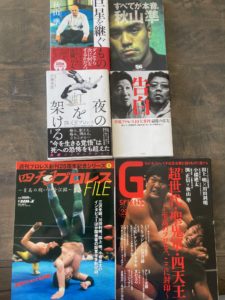
Once again we begin with ICHINOSE’s book as he discusses Akiyama’s progress following his debut. Akiyama notes that most rookies take three to four months to learn the essentials but he believes he got all down within only one month. He credits part of his success to special training sessions with Johnny Smith before the provincial shows, which didn’t always happen with other trainees. As further proof of AJPW’s ambitious plans for him, in his second-ever match Akiyama teams with Masanobu Fuchi and Giant Baba against Smith, Del “Patriot” Wilkes, and Dory Funk, Jr. (RIP).
Ichinose goes over the 1992 Real World Tag League and how Akiyama was hurriedly chosen as Taue’s replacement partner following Tsuruta’s departure due to Hepatitis. Akiyama does his best to carry such a heavy burden and makes it to the finals where he and Taue face Misawa & Kawada in a losing effort. Despite this loss, everyone has come to see Akiyama’s standard and thus adjust their expectations accordingly. However, Ichinose argues that these added pressures weigh Akiyama down and start affecting his performance. 1993 begins with Akiyama’s seven-match Trial Series which is scheduled throughout January. Akiyama first two opponents are “Dr. Death” Steve Williams and Terry Gordy, both of whom crush him effortlessly. His third match sees him defeat Al Perez, but then a week later he loses to Toshiaki Kawada.
Akiyama has much to say about this bout: in SINCERE he recalls Kawada wrestling maliciously after a spinkick hits him in the cheekbone, causing him to lose consciousness and suffer a concussion. However, with time he reflects on this moment and concludes that Kawada was trying to bring real emotion into the match, both from Akiyama and the fans. Around this time Kawada openly criticizes Akiyama’s wrestling style as “a department store of techniques” (SINCERE)/knowing lots of techniques but not knowing how to wrestle, lacking function, and having nothing between the moves themselves (ICHINOSE). Although Akiyama was only four months into his career the press approach Kawada for his earnest thoughts on this elite/special talent and Kawada answers honestly. Ichinose and Akiyama expand on this line of thinking further with Akiyama stating that piling up techniques does not making it pro wrestling (APOD: Moves alone isn’t wrestling? Blasphemy!) Akiyama quickly concludes that Kawada was trying to stop Akiyama from hitting his moves so eagerly and he needed to put more feeling into his offense:
“I realized how important feelings are, more than techniques. Even to execute a single move, it’s not just about making it look good; without a strong attachment to that move, you can’t win.” – Jun Akiyama
(APOD: This is a critical lesson lost on many people who still think that 1990s AJPW was all about crazy moves and head-drops in particular. Far from it: Kawada in the ring and Fuchi as the wrestling equivalent of a foreman wanted to create balanced wrestling that gave plenty of attention to teasing, building, and avoiding techniques before they landed. This was the emotional core of 1990s All Japan, not the impacts themselves. It’s also why Kawada’s wrestling was so refined and built on pragmatism as opposed to outward exertion like Kobashi’s. The reason this lesson got lost on people is that many of the tapes to make it stateside during the 1990s and the plethora of highlights and compilation videos seen during the early days of YouTube emphasized the techniques themselves which was the opposite of what Fuchi and Kawada intended).
Akiyama would apply these lessons a bit later on, but in the immediate aftermath of his Trial Series, and following Kawada’s comments, Akiyama found himself in a strong emotional slump. Reflecting on his progress up to that point, Akiyama credits Kobashi with bringing out his best in his debut and his opponents’ and partner’s skill levels in the ’92 Tag League final. On his own, though, Akiyama believes that his focus on executing techniques beautifully left him lacking in spirit. His doubts worsen when reporters capitalize on Kawada’s comments and regularly write that Akiyama’s matches “lacked color”. Ichinose himself interjects and explains his viewpoint when covering Akiyama and admits that his editorial narrative may have contributed to Akiyama’s challenges during the spring of 1993:
“It’s impossible to show color six months after debuting. That’s a valid point. We all know it’s impossible. Still, if a wrestler is worthy of criticism, I will point it out strictly. Even if it seems like unnecessary meddling, I will write it. I perceived it as an act similar to sowing seeds. If I take the perspective that “Akiyama did his best today,” the manuscript can be completed in no time. However, if I continue to shine a spotlight on small achievements, when the moment of a big explosion arrives, the degree of that leap becomes blurred. The surprise from the viewers becomes hazy. Therefore, I will address clear issues head-on, even at the risk of friction with the wrestlers.” – Hidetoshi Ichinose
(APOD: The wrestling press held much more sway over the business in Japan compared to stateside, especially during the 1990s and particularly over All Japan. They didn’t have their own version of RAW or Nitro, but a highlights show that changed length and timeslot throughout the decade. As such, word-of-mouth hype and live gates were of critical importance. Journalists, therefore, had to balance covering events objectively with using attractive language to encourage people to attend, maintain good business wherever possible and, by extension, keep their publications going).
Akiyama’s problems worsen on March 25, 1993. On that night he teams with fellow rookie Takao Omori against two others closer to his station, Masao Inoue and Satoru Asako. Unfortunately, Akiyama injures his right arm when executing a lariat on Asako and is forced to withdraw from the upcoming Champion Carnival tournament. In SINCERE Akiyama reveals that his slump in 1993 was so bad he contemplated quitting pro wrestling altogether but changes his mind after talking with Kobashi. For most of his first full year as a wrestler Akiyama feels isolated, lacking any genuine friendships in the locker room. He also felt jealousy from the other wrestlers due to his “elite” status which would lead to sarcastic comments about his earnings. Kobashi, however, always left an open door to talk and Akiyama takes him up on that offer late one night. After telling him everything, Kobashi applauds Akiyama for his work thus far, encourages him to keep going, and tells him that he’d regret leaving now in the future. Akiyama states he doesn’t need dozens of friends and having someone at the workplace that truly understands him is more than enough. As such, consulting with Kobashi gives Akiyama an irreplaceable sense of security. While he doesn’t call this an outright debt of gratitude, Akiyama credits Kobashi with saving his wrestling career and states that Kobashi is the reason he chose to go to NOAH when the Exodus happened.
Akiyama returns from injury two months later but while he was gone the roster had undergone a seismic shift with Kawada forming the Holy Demon Army. Prior to that, Akiyama had spent most of his time teaming with Taue in a sort of last vestige of Tsuruta-gun with Kawada on the opposite side with Misawa in Super Generation Army. But with Kawada joining Taue, Akiyama switches to SGA as a sort of trade. Despite changing allegiances, the dynamic between Akiyama and Kawada remains unchanged. Kawada likewise continues to respond to press questions about Akiyama dismissively but this time there’s an undercurrent of encouragement. Ichinose suspects that Kawada is doing to Akiyama what Tsuruta did to him: encouraged him to grow by encouraging him to change his rhythm in matches.
Akiyama goes into further retrospection in INHERIT and credits Kawada as the best of the Four Heavenly Kings. Specifically, Akiyama credits Kawada for having the quickest thinking and ability to turn things around without settling into a pattern as clearly and obviously as Misawa or Kobashi. In both this book and in ICHINOSE Akiyama states he learned the most from Kawada, emulated Kawada’s movements and ideas most of all and, once in NOAH, adopted a Kawada-like role in relation to everyone else. Furthermore, Akiyama recalls Kawada telling him “there is a way to crush them that allows them to sprout” regarding wrestling rookies, which Akiyama considers a special way of elevating someone through losses (APOD: Stan Hansen had a similar philosophy and approached his matches with the Four Kings this way: by destroying them he’d nurture their growth to the point that a loss would improve their career more than a win. The best examples were in Hansen’s match with Kawada in February 1993 and his matches with Kobashi in September 1991 and July 1993).
While on the subject of techniques, Akiyama corrects the record on something in INHERIT: contrary to popular belief, he is NOT responsible for creating the now-widely used Exploder Suplex. Before he started using this technique, a New Japan wrestler named Takayuki/Takashi Iizuka created a similar move called the Blizzard Suplex, which had the same general motions but ended with a leg-hook bridging pin. One day, while training, Kobashi approaches Akiyama and proposes a release version. After fine-tuning the motions and necessary grips, Kobashi perfects the technique and gives it to Akiyama. From then-on Akiyama would use this move as his finisher and then adopt the Wrist-Clutch variation in 1998. Not only does Akiyama credit Kobashi with the creation of the Exploder, he credits Kobashi with taking the time to nurture other wrestlers and give them the open platform to come up with new ideas. By discussing moves back-and-forth and then testing them in an encouraging environment, new techniques emerged. It is from this process that Akiyama creates his other famous technique, the Blue Thunder Bomb.
APOD: This section was as much about other people as it was Akiyama. Kawada and Kobashi prove to be two essential figures in his life, affecting it in different ways. Kobashi acts as an encouraging force, helping Akiyama through a difficult period in his career and giving him the opportunity to test new ideas before applying them in the ring. Kawada, meanwhile, is introduced as a negative force but evolves into a sort of “tough love” figure that encourages his growth via different means. In a way Akiyama was caught in the middle of the ideological debate between curated and refined Kawada on one side and energetic and exertive Kobashi on the other. Though Akiyama would lean more towards the former with time, the latter helped him regain his footing during this tough time. Akiyama’s insight and is once again highly appreciated as he doesn’t pretend things were all rosy and harmonious backstage. What’s more, Ichinose’s input really adds intrigue and shows the important role journalists played in promoting pro wrestling. I don’t think we’ll ever see this kind of introspection from prominent American wrestling reporters or polemicists, which is why this level of mature and thought-provoking writing in a book about pro wrestling is so refreshing.
As always, thanks for reading.