
5-Star BOOK Reviews: Toshiaki Kawada’s Autobiography, Part V
By Alex Podgorski on 4 February 2025
So after being treated like dirt as a high school wrestling trainee, like dirt as an unremarkable and forgettable rookie in All Japan, and like dirt while being poorly used in three different promotions in three very distinct territories in North America, Toshiaki Kawada returns to wrestling in All Japan…where he is promptly treated like dirt. In fact, Kawada’s wrestling career stalls for a long time and, as this chapter reveals, it seems like it takes literal acts of divine intervention for things to align well enough for Kawada to actually start achieving any legitimate success.
You can check out parts 1 & 2 here, part 3 here, and part 4 here.
Chapter 5: The Days of the Dragon Alliance and the Super Generation Army
Upon his return home Kawada is greeted by only one person, Yoshihiro Momota, the other son of Rikidozan who had much less fame compared to his brother Mitsuo. Kawada spends these initial days back looking for a place to live and notices that John “Earthquake” Tenta was sticking around a bit in AJPW. Soon afterwards he goes to the tour bus and notices exceptionally cold stares from everyone in the company and the only person who talks to him is Keiji Ishikawa, who offers him some tea. That single phrase hits Kawada so deeply that he starts crying in private with Ishikawa (APOD: the coldness Kawada experienced during this time doesn’t make all that much sense and no further explanation is given as to why he’s treated this way. So it’s left for us to presume what the cause might be. Is the office mad about his unsuccessful trip abroad? Did that story about him “crossing the border” make AJPW look bad? Were they hoping he’d just quit? Who knows).
Kawada notes that, unlike many of his predecessors to return from abroad, who started getting some kind of push upon return, he is back jerking the curtain like before. He makes it very clear that he thinks there was no point to his foreign excursion, not even picking up any English which he admits having not used in years (APOD: as of 2024 when I met him his English might’ve improved somewhat, but it’s still very rudimentary). He further underscores this feeling of being forgotten and ignored by showing how little effort was put into even giving him basic wrestler treatment:
“The stamp used for the match order in the pamphlet was in kanji as “川田” instead of katakana “カワダ,” but since I returned suddenly, the old stamp was no longer available, and I had to cut someone else’s name stamp. Perhaps it was taken from Mr. Ishikawa’s “kawa” and Mr. Tsuruta’s “ta.” Moreover, it was just “Kawada” without “Toshiaki.” Even after returning from overseas, I received the same treatment as in my debut match.”
Things continue poorly for Kawada when suddenly things start turning for him. In the summer of 1986 AJPW began a working relationship with Riki Choshu’s Japan Pro-Wrestling entity and they were doing a sort of outside invader’s angle with AJPW. (APOD: Though the outside invader angle is often credited to NJPW and Antonio Inoki due to the overwhelming success of his 1995-6 NJPW vs. UWFi angle, it was actually Baba and All Japan who laid the framework for this angle being used in wrestling. I suspect the reasons this often gets ignored is that, a) Inoki’s success with it has gotten much more coverage, and b) Baba’s success as a booker, at least from a Western perspective, is more closely tied to the Four Pillars than to what he was doing in the 1980s) Kawada, looking to use this opportunity, aligned with Genichiro Tenryu. Soon after so did Fuyuki and they became part of Tenryu’s alliance. Then, when teaming together, Kawada and Fuyuki would form the team known as “Footloose”.
Kawada talks about Footloose trying everything to distinguish themselves visually from everyone else: unlike virtually everyone else in All Japan, Kawada and Fuyuki would wear flashy-patterned long tights and throw bandanas during their entrance. Kawada didn’t particularly like this gimmick but he was doing it under advice from his mentor Tenryu: “You can only wear flashy tights when you’re young” (APOD: Tell that to Hulk Hogan, Bret Hart, and the not-so Young Bucks). Kawada mentions buying these cheap bandanas in bulk as part of the gimmick and while he was committed to it he felt “like I was throwing away my own pay every day”. Though he openly expresses disdain for this gimmick/character, he thinks he was good to have done it because he could only get away with this because he was young.
Still, despite the hardships, Kawada gives further credit to Fuyuki for teaching him a lot about wrestling and learning a lot from him. Kawada describes their dynamic as Fuyuki being the brains of the operation (since he was the senior) while Kawada did a lot of the moving. He credits Fuyuki with coming up with ideas for angles, such as after losing a tag match he’d wager shaving their heads if they lost a rematch. Kawada thinks these small things helped him understand wrestling a lot better.
It was also around this time that Kawada started using kicks as part of his signature offense since few wrestlers in All Japan were doing that. The man who helped him perfect his kicking technique was Kōki Kitahara, a freelancer with close ties to the original Tiger Mask Satoru Sayama. Since Sayama went on to focus on shootstyle after his initial masked run and gained a lot of credibility in that field, Kawada believes he was given first-rate help from Kitahara. At the same time he also got some valuable advice from another wrestler, one whose words mean as much now as they did back then:
“When I was younger, I felt like I had to show everything I could all the time, but at one point, Kabuki-san told me, ‘It’s not always about showing all your techniques,’ and ‘It’s better to do it this way here’. I didn’t understand it at that moment, but later on, when I became part of the Super Generation Army, I really felt what Kabuki-san meant.”
(APOD: This exchange will also end up affecting another wrestler with close ties to Kawada, which we will get to when I review another wrestler’s books).
Kawada shifts to reminiscing about Hiroshi Wajima, a sumo wrestler turned pro-wrestler who had a short-lived career in AJPW from 1986 to 1988. Kawada praises him for being stronger and better skilled than most people give him credit for. However, a string of disappointing matches caused Giant Baba to organize a training camp for Wajima that Kawada took part in:
“First, running every morning. From the early afternoon, there was a ring set up in a prefab building right in the middle of the field, and that was the training schedule. Since it was the height of summer, the temperature inside the hut easily exceeded 40* degrees. At that time, Mr. Wajima looked like he was dead when he entered the prefab. Once he got in the ring, he would spar for hours, just like in a match. The signal to start was Mrs. Baba Motoko hitting a bucket instead of a gong. Mr. Wajima would continue sparring for hours on end. After practice, he would douse himself with water from a hose in the middle of the field, looking like he was dead, which left a strong impression on me.
Indeed, it’s hard to imagine that someone who reached the pinnacle of sumo, like a yokozuna, would undergo such tough training and treatment, reminiscent of a sumo rookie, making me feel sorry just thinking about it. ”
*(APOD: Side note for anyone else considering using AI to translate texts. Though these tools are useful they are far from perfect. In my case this tool struggles to catch numbers properly, especially when they’re not written numerically. So when I first translated this it said “4 degrees” but contextually that doesn’t make sense so I’m assuming it meant 40 degrees [Celsius].)
After finishing this training camp (which, incidentally, also had Akira Taue, Kenta Kobashi and Tsuyoshi Kikuchi), Kawada shifts gears to telling us about how he lost his front teeth. For the longest time the general consensus has been that he lost them after eating a lariat from Stan Hansen. As it turns out the truth is somewhat less glamorous or badass yet a bit more gruesome:
“In July 1988, a league competition called the ‘Asunaro Cup’, where young wrestlers competed, was held, and I was able to win. However, during this league, there was an unforgettable incident where I broke my front teeth in a match against Toshimitsu Takano. When I threw him with a German suplex, his back landed on my face, and my teeth got stuck in his back. Several roots of the tooth were sticking out from the gums. When I brought back the broken tooth and looked at it, I saw Shunji’s black skin stuck to it. I headed to the dentist, but a child was receiving treatment first, crying about their baby teeth. It seemed the examination was interrupted, and during that time, I was made to wait in the waiting room, enduring pain.”
Though Kawada would get dentures and could be seen wrestling with a full set of teeth as early as October 1995, he didn’t always wear those as seen with his various 1990s matches in which he bares his “fangs” and looks even scarier.
And what did he get for winning this tournament, aside from at least four lost front teeth? A small trophy and a singles match with Tenryu. Kawada doesn’t think much of the match itself, but it does lead to a big development…which happens because of circumstances outside of his control.
In November 1988 Kawada learns that he will be partnering with Tenryu in the 1998 World’s Strongest Tag Determination League (a.k.a the Real World Tag League), AJPW’s premier end-of-year tag tournament. Kawada is very surprised to learn this given his low rank on AJPW’s totem pole. (APOD: Tenryu’s partner for the 1988 League was supposed to be Ashura Hara but Hara is noted by Kawada to have “disappeared”. In reality Hara was fired by Baba for gambling debts) Kawada further ponders why Baba chooses him to team with Tenryu and not his sempai Fuyuki, only speculating that, upon returning from a second trip overseas, Fuyuki looked “thinner”. And while this is an interesting development, Kawada does note that no one bothers preparing a sash bearing his name ahead of the tournament opening ceremonies. “It felt like a continuation of Stampede”, notes Kawada. Still, Tenryu shows support for Kawada by not wearing the sash prepared for him.
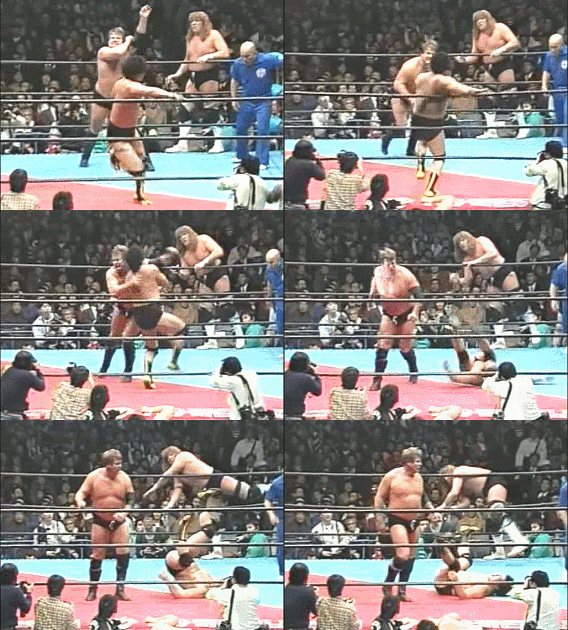
This tournament gives Kawada more motivation than ever before and he fights with all his might. He is quite surprised that he and Tenryu make it to the final, before losing to Terry Gordy and Stan Hansen in the final, which takes place in the company’s favorite venue Budokan Hall. Kawada:
“I was able to stand on the main ring of the Budokan for the first time since becoming a wrestler, and to put it simply, I was “moved.” The audience’s reaction was completely different compared to the first and second matches. It was the very first moment I experienced something in pro wrestling that I had never felt before.”
(APOD: For what it’s worth the Gordy/Hansen vs. Tenryu/Kawada tag match is one of Meltzer’s earliest 5-Star matches and, to be honest, it still holds up incredibly well. It’s an awesome little sprint of a match with a hot crowd, an awesome FIP display from Kawada, and one of the greatest Stan Hansen lariats you will ever see).
As Kawada moves into 1989 he is given more time in matches, which in turn gives him more time to show off his wrestling skill. Though they’re obviously more taxing as they get longer at twenty and thirty minutes long, Kawada feels that he’s given plenty more time to grow and mature as a wrestler. However, despite significant gains, there are still cases where Kawada is still treated as an afterthought and there isn’t a better example than this next one:
“One time, while moving from a venue in Tohoku to Kiryu City in Gunma Prefecture, we stopped at a small service area with only a restroom on the highway, and since we had some time, we decided to take a break. After taking care of my business in the restroom and slowly coming outside, there was no one around. The bus was also gone. I thought they were hiding somewhere as a cruel joke, but no one was in sight. It seemed I had truly been left behind. What to do? This was a service area in the middle of the mountains with nothing around, and no other cars were coming by. After about an hour, I finally managed to talk to a truck driver about my situation, but he didn’t believe me. It’s unreasonable to expect anyone to believe such a story. Moreover, I was in my dirty practice clothes. Anyway, I begged to be dropped off near the Maebashi interchange, and even though it was a highway, I walked down to the road below, taking a series of buses, trains, and taxis to reach the venue. I thought my disappearance would cause quite a stir, but everyone just said, ‘Oh, that.’ I had even been forgotten to the point that I was forgotten about being forgotten. What a ridiculous situation.”
(APOD: How? HOW do you forget a wrestler to such a degree? Unless this is all meant to be some kind of giant rib or there’s some of joke hidden beneath subtext that isn’t translating here this is one of those things that just seems too ridiculous to believe. But given Kawada’s track record it actually makes sense for this to happen to him of all people).
The tone briefly lightens as Kawada talks about drinking with Tenryu, though apparently Tenryu himself didn’t drink all that much but enjoyed getting others to drink. But apparently Kawada could really hold his liquor at that age and posits that, had Tenryu tried to match him drink-for-drink then Tenryu would’ve passed out.
And then the tone shifts again as Tenryu suddenly disbands his stable and soon after Tenryu “departs all Japan and transfers to SWS”. (APOD: Kawada’s more delicate language here might be deliberate because Tenryu was still involved in wrestling at the time of this publication and Japan has a strong “don’t rock the boat” mentality but his word choice deeply undermines what actually happened. Tenryu didn’t just ‘transfer’ from AJPW to SWS like he was changing schools mid-year: he straight up left All Japan after being there for 14 years and being the company’s #2 opposite Tsuruta for a very long time.) While Tenryu’s reasons for departure vary by source (some say it was purely money while others suggest it was due to creative differences with Baba), Kawada supposed it was somewhere in the middle:
“Despite Mr. Tenryu working hard every day, a reporter from Tokyo Sports complained that ‘the match is boring’, and it seems that Mr. Tenryu flipped the table like Seiji Itō. Moreover, the drinks and food that were on the table did not spill on the Tokyo Sports reporter, but rather all ended up on the Weekly Gong reporter. The Gong reporter, having no change of clothes, went to a coin laundry as he was, took off his clothes, and waited in just his underwear until they were washed and dried. He complained that he was mistaken for a pervert by a woman who came in during that time.”
Kawada notes that several of the people he had been tagging with for years departed AJPW for SWS: Fuyuki, Kabuki, Isao Takagi, Yoshiaki Yatsu, and Masao Orihara. Kawada also notes that he received a phone call from Tenryu inviting him to SWS but Kawada doesn’t really explain if he was interested or not (APOD: the translation here is a bit off and ambiguous. Additionally, Kawada’s feelings of loneliness and being lost in the immediate aftermath of the Tenryu Exodus really dispel many of the ‘thick-as-thieves’ narratives around Kawada and Misawa that circulated for years, especially as we see things from his perspective here).
Soon afterwards, Kawada notes a singles match he has with Kobashi that gets high praise and soon after those two and a few others are invited to referee Kyohei Wada’s house for a “young wrestlers only” barbecue. It is here where Giant Baba plants the idea in their heads that they should work hard to take down the wrestlers higher-up on the card. And thus was born Chosedai-gun, better known as The Super
Generation Army.
Kawada describes wrestling in front of packed venues around this time, with Budokan Hall shows leading to “platinum tickets” and such high demand for their Korakuen Hall shows that fans had to send in postcards and won tickets in a lottey. It was also during these SGA years that Kawada’s style changed as well: though he kept his kicks he stopped jumping around. He also started using the powerbomb knowing that it wasn’t a move for smaller people but he did it out of stubbornness to show he could do it as well (APOD: and as luck would have it Kawada would add his own small pin on it, to the point that his Soul-Infused Powerbomb would become a highlight of 1990s AJPW matches). He also describes wanting to stand out from everyone else, including his peers, by picking a truly distinct style. As he puts it, “I also wanted to do pro wrestling that understood pain, rather than just jumping and leaping.” (APOD: This is shown in Kawada’s selling; as many online commentators, myself included, have noted over the years, Kawada is one of the best sellers in modern times. Ichinose describes Kawada’s approach to selling as a TV chef wanting to convey the smells and taste of food to an audience which he does through facial expressions and body movements. This has since become one of Kawada’s calling cards and is one reason why he’s still so revered among various corners of the wrestling fandom).
Kawada: What I was seeking was precisely that. I had decided in my heart that I didn’t need ‘bright and fun’, which All Japan was promoting as ‘bright, fun, and intense pro wrestling’, and that I would go with just “intense.” I thought I couldn’t do it all if I was told to do ‘bright, fun, and intense.’”
(APOD: “Bright, Fun, and intense pro-wrestling” – akaruku, tanoshiku, hageshī puroresu – was the original AJPW tagline and marketing term for the new style that came in 1989 with the shift from the old Showa Era to the new Heisei Era. Baba wanted his company’s style to shift in concert with the changing era which meant leaving some things behind. Though there are many stylistic differences between Showa AJPW and Heisei AJPW, two stand above as most important: 1) a shift towards away from Showa-era opacity towards a new clarity, expressed in the form of clean and decisive finishes; and 2) a focus on sportsmanship and honor, doing away with the Dusty finishes, double count-outs, and other ambiguities that, in Baba’s view, had cost AJPW the trust of its fans. This nomenclature would eventually be replaced with Oudou/King’s Road both in Japan and abroad, but that wouldn’t happen for another three years or so.)
Kawada goes on to note how he used the change in the roster to his advantage, cultivating in him a rival in Akira Taue. He gives Taue credit where it’s due, pointing out that Taue improved drastically once they began facing off in tag matches throughout the early 1990s. He also puts Tsuruta over something strong, noting how physically strong he was, even compared to guys like Hansen or Steve Williams. He further notes that teaming with Misawa allowed him “to do things freely”, appreciating tagging with him during these crucial years.
He also says nice things about his opponents. First he notes just how vicious Stan Hansen’s Western Lariat really is:
“I had experienced lariats since my rookie days, even taking them when I went in to help as a second, but they were truly tough. The impact wasn’t just from the moment the Western Lariat hit; it was more about hitting the ground and banging my head afterward that really hurt. There were times when I had a headache and had to go to the hospital after the match. Hansen’s Western Lariat wasn’t just about swinging his arm; with his barrel-like body, he put all his weight into it, causing significant damage.”
He also praises Steve Williams for his strength, but notes that he’s also “clumsy and awkward.” (APOD: Kawada’s words here aren’t meant to be a knock or a criticism. If pro-wrestling is meant to be seen as a precission art then someone who is ‘clumsy’ – or, in other words, ‘imprecise’ – would actually work to their benefit by giving them an aura of danger and risk. And since in Japan you were just expected to roll with the punches and brush off mistakes if they came from an established and respected senior then ‘Dr. Death’ being clumsy was just something to work with rather than against). Finally, Kawada has a few nice words about working a title match opposite Misawa in October 1992, calling him a wonderful opponent, before being caught off guard with Tsuruta’s Hepatitis diagnosis around that same time and how now (in 2003 when this was published), he was starting to feel the effects of his previous injuries.
APOD: Unfortunately Kawada glosses over plenty of events great and small that took place over a six-year span. From Misawa’s unmasking to his thoughts about particular big matches, Kawada leaves a lot unanswered. He also doesn’t go into his relationship with Misawa all that much (if you want more on their somewhat complicated friendship then I suggest going back to Ichinose’s Four Pillars Bio since that includes a passage on the time Kawada allegedly gave Misawa a black eye in 1991). He also says next to nothing about Masanobu Fuchi, who is an important player in the big matches from this period, including the six-mans that defined AJPW’s biggest shows throughout 1990, 1991, and 1992. He also doesn’t seem to be all that interested in going into further detail about all these big developments that happen throughout the late 1980s and 1990s, and even misses the opportunity to talk about his appearance on the AJPW/NJPW/WWF Wrestling Summit supershow. And despite the sheer enormity of the SWS Exodus there isn’t all that much about the event that Kawada adds to it. So while there were some noteworthy happenings during this chapter it really feels like he could’ve fleshed a few things out but ultimately chose not to…or maybe he just doesn’t remember anything else of note from this period.
Thanks for reading. That’ll do it for this chapter. Next time: The Era of the Four Heavenly Kings.