
5-Star BOOK Reviews: Toshiaki Kawada’s Autobiography, Part IV
By Alex Podgorski on 29 January 2025
And now we have one of the most interesting of chapters: Kawada’s journey to America. Like most if not all Japanese rookies, Kawada was sent abroad for seasoning. It was hoped that he would come back with knowledge of other wrestling styles and techniques, plus a stronger ability of communicating with the audience. Unfortunately, Kawada’s experiences abroad would leave him at best disappointed, at worst embittered.
You can check out parts 1 & 2 here and part 3 here.
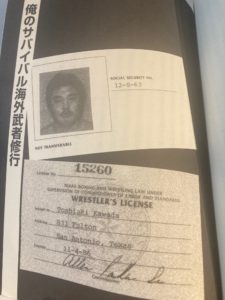
Toshiaki Kawada’s wrestling license circa 1986.
Part I: Texas
Kawada describes this journey as “long-awaited” and he begins this chapter on a more optimistic tone. As he departs Narita Airport for San Antonio, Texas, he’s given a new contract to sign (without a signing bonus) and is told to sign a statement stating he wouldn’t join any other organizations. This new clause, Kawada suggests, stems from Shiro Koshinaka jumping ship to New Japan while abroad, so AJPW’s taking precautionary measures. There is only one reported covering his departure, but Kawada notes that this is better than nothing. Kawada arrives in San Antonio and seeks out Chavo Guerrero (Sr., a.k.a. Chavo Classic) but by the time he arrives Chavo is gone from the San Antonio territory.
Kawada then finds himself being booked by Gary Hart in Texas All-Star Wrestling (TAW) and finds himself in a thrown-together tag team alongside Kodo “Samson” Fuyuki as “The Japanese Force”. Perhaps the only noteworthy thing from this team is that Kawada had at least one match with a rookie Shawn Michaels when he and Fuyuki took on The American Force (Shawn Michaels & Paul Diamond) on December 4, 1985. But this tag team is short-lived as Fuyuki’s visa expires and so he returns to Japan shortly afterwards.
(APOD: As an aside, Kawada puts small footnotes on the bottom of different pages to give more context to whom he’s talking about so that the reader might get a better understanding. The stuff he puts here is purely factual, neither flattering nor critical. For example on HBK he writes: ‘Shawn Michaels, born in July 1965 in Texas, USA. 186 cm, 105 kg. He reigned as the AWA World Tag Team Champion, WWF World Tag Team Champion, and WWF World Heavyweight Champion.’)
Then Kawada shifts to something called “The Mexico Border Incident”, which, apparently, stirred up some minor trouble back home based on how it was covered by the Japanese wrestling press.
Kawada and Fuyuki had rented an apartment together but with Fuyuki gone back to Japan Kawada was left paying two peoples’ rent while being paid a curtain-jerker’s salary. Kawada also had to rely on other people to be driven to venues, and one day he hitched a ride with a Mexican wrestler since the venue that day at the border between the US and Mexico. This wrestler invited Kawada to go shopping with him on in Mexico but Kawada was concerned since he didn’t have an American passport. With that guy being his only way of getting to the venue Kawada went with him. As they returned this Mexican wrestler instructed Kawada to reply “yes” to all questions. Not knowing any better Kawada did as he was told, only for him to answer “yes” to a question he shouldn’t have and then being barred from entry, leaving him stuck in Mexico. Kawada stayed at a cheap hotel for a night until the Mexican returned with his family and he was told to pretend to be a family member. So here was Kawada surrounded by some random thrown-together group of people and he had to pretend they were all related. Sure enough, the border agents bought it, and he returned to the US. For Kawada this was a situation of panic, but the person who conveyed the story to the Japanese described it in a way that implied that he went to Mexico on vacation and “to buy a woman in Mexico”. Though it was implied to be treated as a joke, Kawada still took it very badly since it didn’t include his perspective.
Part II: Calgary
Upon returning from Mexico Gary Hart tells Kawada that since he’s not in a tag team he is no longer needed. Kawada calls Baba’s right hand man Akio Sato for suggestions and Sato tells Kawada to try Calgary. For some reason he is warned by Sato to not trust Mr. Adachi (Mr. Hito) but ends up doing so anyway since Hito offers Kawada a room in his house. But because of how little he was being paid he struggled to keep up with rent, and he also had to rely on Hito for transportation in Calgary. (APOD: Calgary, like most big cities in Canada, has passable but underdeveloped public transportation compared to most European cities and ESPECIALLY compared to Japan. And with the venues in the Stampede territory being so spread out having car access is critical, which is why this leg of Kawada’s journey might actually be his worst experience).
Kawada: “In the waiting room, I was handed a dirty, tattered mask and told to put it on and fight. That person said it with an air of superiority. Without even having time to be surprised, the next words were, ‘Become a violent guy in the ring.’”
(APOD: This is about as close as Kawada gets to directly criticizing or insulting anyone in his writing. It’s clear from Kawada’s point of view that this person cared so little of Kawada as a wrestler that he was just handed a mask and expected to perform with it. This might not be 100% correct but based on time and place the person whom Kawada is talking about here may have been Stampede’s booker at the time, Bruce Hart). Unfamiliar with the character Kawada simply “howled violently”. And thus was born the character Black Mephisto. For his efforts Kawada was paid $CAD 200 per week for eight matches (APOD: Christ Almighty, talk about the whole ‘hot dog and a handshake’ stereotype) and did this for several months, all without getting much praise or recognition from the bookers.
As if the pitiful pay wasn’t bad enough, Kawada also describes going on long drives with Mr. Hito, sometimes taking ten hours one way (APOD: it’s Canada so it totally checks out). At times it was also freezing cold (APOD: You don’t know cold until you’ve felt Prairie winter cold), and Kawada only had a thin vinyl jacket to keep warm. There were also times Hito had to turn the heat off to conserve gas, leaving Kawada closer and closer to freezing to death, only for him to wrestle a crappy opening match and then repeat the journey back under these same conditions. As if that STILL weren’t enough Kawada also describes almost getting in trouble at a DUI checkpoint and having to throw beer out, apparently surprised that passengers aren’t allowed to drink in the car.
Part III: Montreal
After not being used for three weeks and having no money to his name Kawada is sacked by Stampede and he is sent to Montreal. In one of his earliest encounters he meets a young Chris Benoit who, at the time was “still thin”. It’s only in a retrospective aside that Kawada notes how Benoit’s body changed so much and speculates if “it’s the power of drugs” or just considerable effort.
Kawada ends up living alone in an apartment in Montreal and finds it unexpectedly enjoyable to live alone for once. But in his apartment the shower barely works, the window is broken and couldn’t be locked, and when he opened it he was stricken by an awful smell coming from the garbage dump outside. Now he understands why that room was usually empty.
While in Montreal Kawada tends to get to venues with Rick Martel, whom he describes as “the first proper professional wrestler I encountered since coming overseas. He had a personality that was close to that of a Japanese person and was a good guy.” He also gets introduced to Tom Zenk who suggests Kawada try steroids. Kawada ultimately does them, but only for three weeks. (APOD: Years ago I stumbled on some obscure article that may or have not been written by Tom Zenk himself but it described his accounts of working with Kawada in Quebec [it’s are from the now-ancient GeoCities sites and this is the closest safe link I could find]. Zenk implied that Kawada began taking steroids out of self-doubt and because of image issues; however Kawada very clearly refutes this. Though steroids were all the rage in the 1980s and 1990s in wrestling, Kawada only took them for about three weeks and then went cold turkey, which is critical because it would’ve fucked his career up royally. Performance-enhancing drugs, and indeed recreational drugs in general, are verboten and highly stigmatized in Japan. Obviously there are ways to get them into the county but if you get caught you’re in serious trouble. Not as much as in, say, Singapore, but still serious punishment enough. “Dr. Death” Steve Williams learned this the hard way as he was caught with marijuana at Narita Airport and was essentially barred from entering the country for a full year. The only reason he didn’t suffer a worse punishment is because, allegedly, Giant Baba pulled some strings with the Japanese authorities.)
Then despite getting some promising results while wrestling in Montreal for about four months, Kawada learns that not only does he not have a proper working visa for Canada, but he doesn’t have a visa period. As such, Kawada hurriedly gets back to Japan, with only a few thousand yen to his name and some debts that he’d have to pay over several years. As he leaves Quebec he does get treated to dinner by Prince Tonga (Haku) and gets a rare treat in the form of a first class flight from Vancouver to Tokyo.
(APOD: Kawada’s foreign experiences are also important in relation to Misawa’s. Whereas Misawa obtained some useful training in Mexico which helped build his junior heavyweight arsenal enough for him to adequately fill the role of Tiger Mask II, Kawada’s stateside experiences left him somewhat bitter and dissatisfied. From one place to another he was used as enhancement talent, gaining little overall experience and being paid next to nothing. There is also a critical distinction to be made between (All) Japan and America: Japanese wrestlers were mostly paid less but had lots of things like transportation and accommodation taken care of by the office while Americans were paid more but had to manage more non-wrestling-related matters on their own). For a modern example, without going into specific details, I’ve heard that Kazuchika Okada’s NJPW salary as their unquestioned ace is still less than most NXT wrestlers before deductions, so it’s no wonder that he took a position with AEW that, no joke, might be close to ten times what NJPW was paying him).
Thanks for reading. That’ll do it for this entry. Next, time: Chapter 5: The Days of The Dragon Alliance and the Super Generation Army