
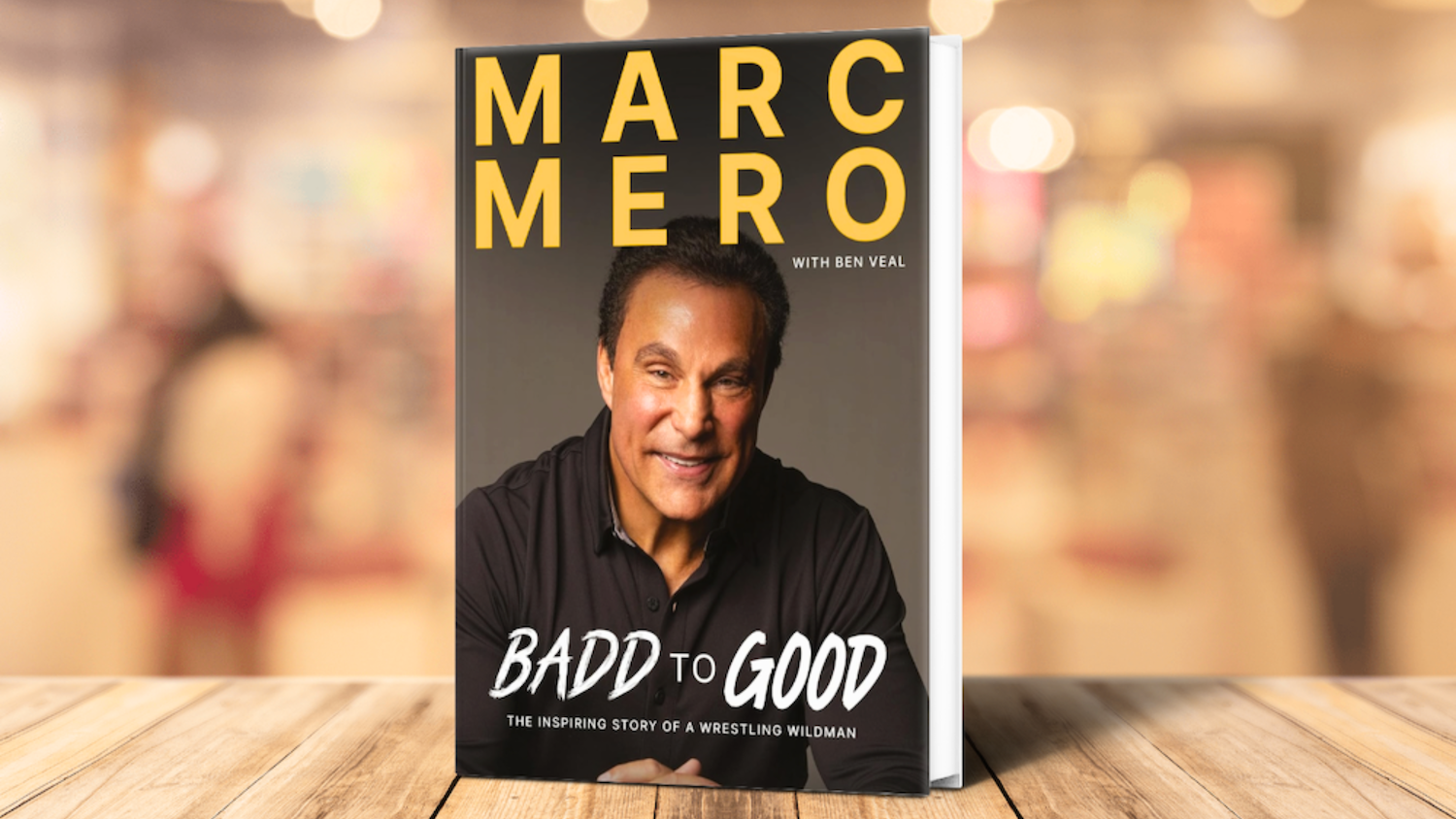
Book Review: “Badd to Good”
By Ross Owen Williams on 2 May 2025
Review: Badd to Good by Marc Mero and Ben Veal
Whatever happened to Marc Mero?
That was a question that would now and then pop into my head when thinking about wrestling after the year 2000. Recalling the earlier days of my fandom at the start of the 1990s, I was introduced to the WWF through the wonder of early-days Sky television and quickly fell in love with sports entertainment. That said, I didn’t realise there was a world of it outside of the World Wrestling Federation until I happened upon a rogue copy of Pro Wrestling Illustrated in a newsagent in early 1991 and became aware there were other promotions out there – and, having discovered WCW in this way, kept my eyes open in the TV magazine listings (yes, long before there was a search function, on-demand, or even an on-screen ‘what’s on’ guide!) to see if I could feed my fandom with more than just the WWF. Initially, thanks to post-midnight ITV programming and, later, German channel DSF, I was able to check out WCW.
It was ‘alright’ – after all, it was wrestling, and that was good enough for me at that time but the music, the look, the production values, the characters all felt a fair few steps away from what was being offered by the WWF.
However, over the course of the first few years of the 90s, there were a few WCW wrestlers I’d go out of my way to watch, including Vader, ‘Stunning’ Steve Austin, Brian Pillman, Ricky Steamboat and, of course, a charismatic newcomer named Johnny B. Badd.
I watched over the years as this flamboyant character developed and improved as a wrestler, becoming one of WCWs most capable performers by the mid 90s, and found myself hoping that, one day, he’d make the jump to the WWF where he would unquestionably fulfil his huge potential and become one of their biggest stars.
I well remember watching WrestleMania XII in 1996 and experiencing something of a bad taste in my mouth after having just watched the Ultimate Warrior squash Hunter Hearst Helmsley in seconds when the show cut to Todd Pettengill backstage introducing the newest WWF superstar, ‘Wildman’ Marc Mahro (sic). Overlooking Todd’s dodgy pronunciation, I immediately perked up – in a promotion increasingly lacking in stars and talent, Mero was surely going to be a proverbial shot in the arm and swiftly be climbing the card to stand alongside Bret Hart, Shawn Michaels and the Undertaker as a top star, engaging in thrilling matches and stories against the likes of Owen Hart, the British Bulldog or Vader.
Fast forward to Survivor Series 96, less than 8 months later, as Marc led a rag-tag combination of over-the-hill grapplers and a fresh-faced rookie into a mid-card battle, I found myself thinking ‘what the heck happened?’ When team captain Marc was quietly eliminated and the rookie, some guy called Rocky something-or-other, overcame 2-on-1 odds to get the win, I couldn’t figure out how the guy behind Johnny B. Badd ended up as just ‘some other guy’ on a roster desperately in need of stars.
It turns out that I wasn’t the only person questioning this – the man himself was trying to figure it out too.
All of this, including his training, his relationship with Dusty Rhodes, his runs in WCW and the then soon-to-be WWE, his on-screen clashes with then-wife Rena/Sable, the transformation into his ‘Marvellous’ character, the sudden and surprising breakdown of his marriage and so much more, is thoroughly covered in Badd To Good, a recently released autobiography penned by Marc and Ben Veal.
The first 60 pages deal with Marc’s often heartbreaking upbringing and it’s quite an eye-opener – the man lived through a lot before he ever hit our screens, the sort of stuff that, if it had been handled in a sit-down interview with Jim Ross a la Mick Foley’s infamous segments in 1997, would likely have led to a deeper connection between Mero and the audience. Perhaps Marc didn’t want to bring any of this up, perhaps WWE didn’t want to mention it, perhaps neither side gave it any thought – but, coming away from the book, it certainly struck me as a missed opportunity.
Now, for me and, I suspect, a majority of fans, the measure of a wrestling book is how quickly things move into the ring and, then, how motivated the reader is to keep turning the pages once it comes to the wrestler’s run in the big time. On that front, this book is a winner – I raced through the 250 pages dealing with Marc’s wrestling career in just a handful of days, thoroughly engrossed in his perspective on how it all played out.
Any 90s wrestling fan will find much of interest discussed, from his stellar run as Johnny B. Badd in WCW to his contract negotiations leading up to the WWE debut – and it’s the time he spent in WWE that makes for the most gripping reading, as what should have been the peak of the career for a hard-working, talented individual in the top promotion of the industry all unravels, and the huge damage this time does to Marc both professionally and personally. That’s not to say that there weren’t positives from this time, as Marc makes it very clear that, at least financially, this period was by far the most successful time of his life – yet for all the financial positives of having received the first-ever guaranteed contract in WWE history, it seems to hang like a sword of Damocles over his relationship with everyone from Vince McMahon to the boys in the back, creating a subconscious barrier that was never quite overcome by anyone in the promotion. It’s one of those huge ‘what if?’ discussions – what if Marc had accepted the standard WWE ‘opportunity’ contract and not insisted on bringing Rena on the road with him? How would his run have gone? How would his marriage have gone? It’s the old devil’s pact – he and Rena made their millions but at what cost?
Marc comes across as honest, contemplative, but not bitter or resentful about it – despite, some might say, there being plenty of reason to be so. Indeed, the way Marc discusses adversity and disappointment demonstrates just how well he is fitted for the career he has carved out this side of the millennium as a motivation speaker – and there’s much motivation to be found in the pages of this book, including the quotes which open each chapter, musings on positivity that I’ve been inspired to share with my family already.
When you consider that Marc’s main run as a wrestler, from day one of training to his final night with WWE, amounted to less than a decade, it’s not the life-defining term that most grapplers carve out in the industry and yet, it’s how most wrestling fans will remember him and what is most likely to make them pick up his book. However, within its pages, they’ll learn about what has since and will unquestionably continue to define Marc’s life – his Champion of Choices initiative and the huge positive impact he’s had on young people worldwide, something that absolutely must be applauded, especially as times get increasingly tough for young people in the modern age of incessant social media and comparison anxiety.
Overall, this book is a rollercoaster of highs and lows, wins and losses, about a man who almost lost himself on several occasions but fought back with tenacity and determination. It’s told with honesty, vulnerability, and absolutely no ego, all capably conveyed in Marc’s voice thanks to the fine penmanship of Ben Veal, who has done a superb job in helping Marc delve deep into the questions that most readers will want covered.
So, whatever did happen to Marc Mero?
Pick up this book and find out – you won’t be disappointed.
Ross Owen Williams is the co-author of the autobiographies of Bob ‘Hardcore’ Holly (The Hardcore Truth), Al Snow (Self Help), and Dylan Postl aka Hornswoggle (Life is short and so am I), as well as the writer of four business books (The RecruitMentor series and 365 Days of Advice) and one feature film (Winter Ridge).